

Four Russian military planes operating within the Alaskan Air Defense Identification Zone were intercepted by American fighter jets on September 24. Two Su-35 fighters and two Tu-95 strategic bombers were involved in the incident, which took place without the Russian aircraft ever entering Canadian or American sovereign territory. However, NORAD’s response was remarkably successful, deploying an E-3 surveillance plane, four F-16s, and refueling tankers to shadow and identify the aircraft.
The calculated maneuver is what made this encounter remarkably reminiscent of Cold War standoffs. Russian flights along this corridor are not unusual; they happen quite frequently. However, the flights carried more weight given the continued tensions surrounding Ukraine, NATO airspace violations in Europe, and the increased rhetoric from world leaders. They were signals sent out over the skies, not just test runs.
Famous for their long endurance flights and remarkable durability, the Tu-95 bombers are strategic instruments of intimidation from the Soviet era. They present a multi-layered message of continuity and modernization when paired with sleek, contemporary Su-35 fighters, creating a combination that is both symbolic and practical. In contrast, the U.S. response was extremely effective and not improvised, proving that preparedness has not decreased despite the proliferation of crises in other countries.
Table of Aircraft and Incident Details
| Category | Details |
|---|---|
| Event | NORAD intercepts Russian military aircraft near Alaska |
| Date | September 24, 2025 |
| Aircraft Detected | 2 Tu-95 Bear strategic bombers, 2 Su-35 fighter jets |
| Location | Alaskan Air Defense Identification Zone (ADIZ) |
| Response | 1 E-3 early warning aircraft, 4 F-16 fighters, 4 KC-135 tankers scrambled |
| Airspace Status | Russian aircraft stayed in international airspace, did not enter U.S. or Canadian sovereign territory |
| Frequency | Ninth such incident reported in 2025, part of recurring Russian flights |
| Significance | Seen as a test of U.S. readiness and NATO solidarity |
| Reference | CBS News: https://www.cbsnews.com/news/us-fighter-jets-russian-warplanes-alaska |
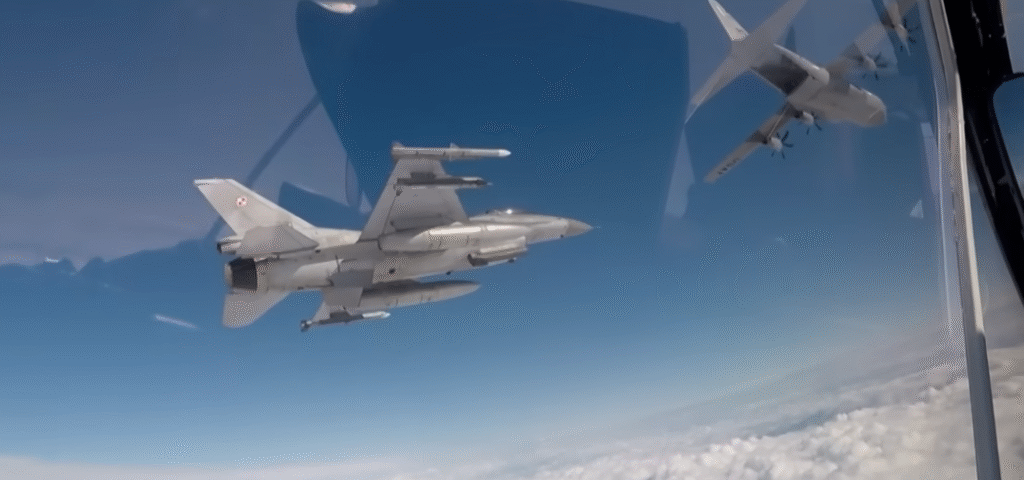
Deterrence talks have become urgent after NATO allies in Eastern Europe reported Russian jets violating Polish and Estonian airspace in recent days. Estonia invoked NATO’s Article 4 and demanded formal consultations, while Poland even shot down drones that had strayed into its skies. In contrast, the flights close to Alaska were still technically allowed. However, legality does little to dispel the impression of deliberate provocation, which is especially novel in its nuance.
Although Alaska continues to be an important front line, the public’s focus frequently shifts away from these northern encounters. Russian maneuvers and American vigilance are tested in its skies. The intercepts serve as a reminder to Alaskans that they live on the brink of strategic competition rather than just being abstract headlines. They are aware that location determines fate, and their state more than any other demonstrates the physical proximity of rivals.
The political fallout is just as severe. NATO Secretary General Mark Rutte echoed former President Donald Trump’s surprisingly firm stance that NATO allies should shoot down Russian aircraft if they violate sovereign airspace. Such language emphasizes how seriously these flights are taken, even when they do not cross international borders. It also calls into question escalation—if a mistake is made, what starts out as routine identification could turn into a spiral.
NORAD is a prime example of joint vigilance through strategic partnerships, integrating Canadian and American resources into a cohesive defense architecture. Since the Cold War, when communication lags occasionally resulted in coverage gaps, this unity has significantly improved. Coordination is much quicker now, guaranteeing that every interaction is not only recorded but also actively discouraged.
It was no coincidence that the flights were timed. The Russian action seemed well-timed to remind enemies of Moscow’s reach as NATO struggles with numerous airspace violations in Europe and the U.N. discusses security mandates for crisis zones. Russia is able to participate in discussions that go well beyond the Arctic by using these long-range patrols. In many ways, its methods of applying pressure are extremely varied—drones in Poland, bombers near Alaska, and always layered with plausible deniability.
These incidents serve as a reminder and a rehearsal for the United States. Every intercept serves as a readiness test and an opportunity to verify endurance, coordination, and reaction times. These are high-stakes exercises that are carried out in real time while enemies watch. They convey to the public that vigilance is ongoing rather than sporadic. Security is a continuous process rather than a one-time assurance.
In the real world, these interactions bring back memories of a time when American pilots would wave to Soviet crews over short aerial distances. However, the current context is more acute, influenced by Russia’s increasingly audacious actions, NATO’s increased commitments, and Ukraine’s destruction. The stakes are noticeably higher, but the echoes are familiar. In the Alaskan skies, every pass is a piece of a larger chessboard, where every move is recorded and every signal is decoded.
The psychological effects are not to be understated. Russia uses a very obvious tactic by flying close but not too close: it creates uncertainty. It involves reminding without inciting and probing without crossing. This gray-zone strategy requires constant readiness without defined thresholds, making it just as difficult for military planners as open confrontation.
