

This season, a unique visitor has been making its way gracefully and cautiously along Australia’s sunny shores: bluebottles. The transparent, blue-or purple-tipped floats of these drifting marine colonies have become a common sight on beaches from Queensland to Victoria, inspiring both locals and visitors to prepare thoughtfully. They draw attention with surprising beauty, much like windblown kites stuck on the high tide line, but their existence also serves as a reminder that nature’s rhythms can occasionally deliver surprises in addition to sunshine.
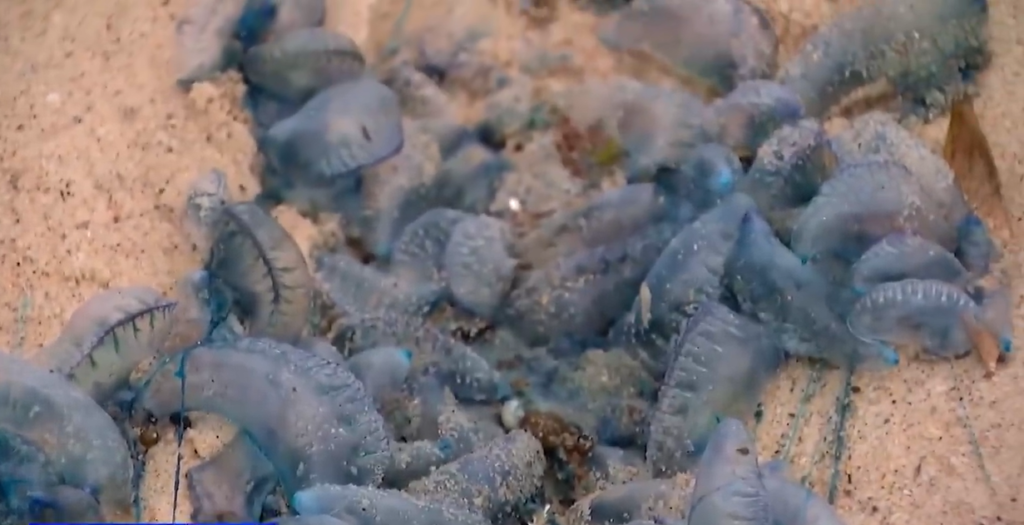
On a bright morning, a young family relaxes near the surf and discovers swarms of bluebottles dotting the damp sand. For many beachgoers, the encounter starts innocently. Their pear-shaped floats, which like tiny ships drifting on an ocean of tan and froth, shine in the sunlight, fragile and yet alluring. However, those lengthy, trailing tentacles, which may reach lengths of several meters, are far from harmless; they contain stinging cells that can inject venom into human flesh, leaving behind a searing, intense sensation that lasts longer than expected.
As I talked to residents observing these yearly visits, I was reminded of a beach trip experience from my childhood: the sting on a fingertip after mistaking a bluebottle for a shell. Their voices were full of appreciation for the drama of the ocean, but they also carried a feeling of respect that had developed via experience rather than fear. A seasoned surf swimmer compared bluebottles to “armadas blown in by the sea’s breath,” a beautiful description that encapsulated how these animals appear to arrive in large numbers when the timing of the tide and the wind are especially favorable.
| Item | Details |
|---|---|
| Scientific Name | Physalia utriculus (Pacific man-o’-war) |
| Common in Australia | Summer on eastern coasts; autumn/winter in southwest |
| Current Event | Massive surge reported on Victorian beaches, rare for southern waters |
| Dangers | Painful stings; serious for children/allergic individuals |
| Cause of Recent Surge | Onshore winds and unusual ocean currents |
| Notable Sightings | Ocean Grove, Diamond Bay, Mornington Peninsula |
| Reporting Platform | Sightings logged via iNaturalist and BlueBottle Watch project |
| Not Fatal (Australia) | Yes, no deaths recorded from southern hemisphere species |
It has long been known by scientists that bluebottles are not lone jellyfish but rather intricately arranged groups of specialized zooids, each of which fulfills a specific function that when combined allows for feeding, stinging, and reproduction. They have a sort of collective intelligence as a result of their degree of cooperation, much like a swarm of bees whose individual individuals each have distinct jobs but whose overall movement feels deliberately guided by wind and current. Although these colonies drift aimlessly as we understand it, this organic choreography has developed over millennia, and the patterns they create can be unexpectedly instructive about more general environmental processes.
Through websites like iNaturalist, academics and citizen scientists have been monitoring bluebottle occurrences in recent days, combining scientific data with citizen observations in a highly effective cooperative effort. Experts intend to create predictive insights that may eventually assist beachgoers in planning their visits and lowering risk by charting the times and locations of sightings and superimposing that data with wind directions and sea surface temperatures. Because it turns infrequent observers into active participants in a common understanding of marine life, this kind of participatory science feels very novel.
Natural dynamics provide a tenable explanation for the rise in reports this season: swarms of these floaters have been pushed toward shallower waters by persistent onshore winds and minor changes in oceanic currents. Residents and tourists have been shocked to discover whole sections of sand patterned with bluebottles’ blue sails in areas of Victoria where they are not usually as prevalent as they are further north. One beachgoer on the Mornington Peninsula acknowledged that she initially mistook the shapes for pieces of colored plastic, a misconception that has been repeated on social media.
At one point, I saw how much social storytelling about bluebottle experiences had evolved. Instead of only recounting stings, it now included sympathetic advice about identifying the forms before touching them and discussing practical first-aid procedures. According to a buddy, their community group talked about not just where they swam but also how they should navigate the beach with greater awareness, viewing each interaction as a chance to grow rather than get anxious.
The treatment of bluebottle stings is simple yet accurate. After washing the afflicted area with seawater rather of fresh water, which may cause more stinging cells, experts recommend soaking the skin in warm water that is tolerably heated for at least ten minutes. This heat greatly lessens discomfort by breaking down the venom’s protein structure. It’s heartening to hear from folks who found relief just by knowing what to do, and the instructions’ clarity has made them easy to follow and quick to distribute on busy beach days.
Although bluebottle stings are rarely fatal, they can be excruciating and require special care for sensitive people or young children. The presence of vast numbers has surprisingly worked to enhance prudence rather than terror, according to lifeguards. Many swimmers have chosen safer swimming locations or protective swimwear due to the colonies’ obvious presence on the sand and in shallow swells. This caution has, somewhat surprisingly, contributed to a decrease in sting reports even as sightings have increased—a particularly positive result that demonstrates how awareness can directly influence safety.
Additionally, current study indicates that there may be several species of these floaters, each of which reacts differently to tiny environmental stimuli. There are now different types of bluebottles with somewhat different movement and timing patterns among what was originally believed to be a single group. This biological subtlety highlights the complexity of marine ecosystems and the ways in which little variations can affect the location and timing of particular organismal groups’ appearance along coastal margins.
People express concern about bluebottles in community forums and seaside discussions, but they also express a fresh appreciation for the diversity of marine life that interacts with human pleasure. Residents of the coast now use the arrival of these colonies as an opportunity to exchange local knowledge, pose questions, and foster a feeling of community preparedness that goes beyond the floaters’ immediate presence. In many respects, this interaction is representative of a more general, optimistic change — one in which people approach the cycles of nature with respect, curiosity, and a propensity for practical planning rather than dread.
From that perspective, the periodic return of the bluebottle is not just a barrier to swimming but also a call to strengthen our ties to the natural world. Families plan beach days with excitement and careful caution, lifeguards fine-tune their alarms, and swimmers modify their plans. These adaptations show that coastal populations have a very adaptable mindset that welcomes the joys and sometimes the annoyances of living by the sea.
For me, what started as a brief childhood recollection of a sore fingertip has developed into a more comprehensive tale of adaptation, education, and coexistence at the border between land and sea. Although bluebottles are only temporary visitors to our beaches, the discussions they start and the information they produce as a group last far longer than the ebb and flow of a single season.
