

The Boley Building, a masterpiece that is frequently overlooked by casual glances but never forgotten by those who pay close attention, stands proudly beneath the shade of Kansas City’s tall trees and rustling streetcars. Constructed in 1909 by the incredibly visionary Louis Curtiss, this six-story building introduced a design philosophy so revolutionary that it would take almost half a century for it to become commonplace.
Curtiss was dreaming in steel at a time when the majority of buildings were anchored in masonry. He created a light-filled, especially hopeful, and unrestricted space by replacing the heavy brick walls with a curtain of glass stretched over steel columns. His curtain-wall façade, which was held up by columns of hot-rolled steel, served a purpose beyond aesthetics. Across continents, it symbolized a structural rethinking that would later characterize contemporary skyscrapers.
Curtiss’s strategy worked incredibly well. He provided the literal and symbolic transparency that urban centers would later seek by tearing down heavy walls and focusing on openness. Sunlight spilled across workspaces due to this openness, changing how people moved, worked, and interacted within the building.
Boley Building – Architectural & Historical Snapshot
| Attribute | Detail |
|---|---|
| Name | Boley Building |
| Location | 1130 Walnut Street, Kansas City, Missouri |
| Year Completed | 1909 |
| Architect | Louis Curtiss |
| Style | Art Nouveau / Early Modernist |
| Structural Innovation | First U.S. building to use glass-and-metal curtain wall + hot-rolled steel columns |
| Original Purpose | Boley Clothing Company headquarters |
| Current Use | Headquarters of Andrews McMeel Universal |
| Restoration Architect | Helix Architecture + Design |
| Historic Recognition | Listed on the National Register of Historic Places (1971) |
| Reference | Wikipedia – Boley Building |
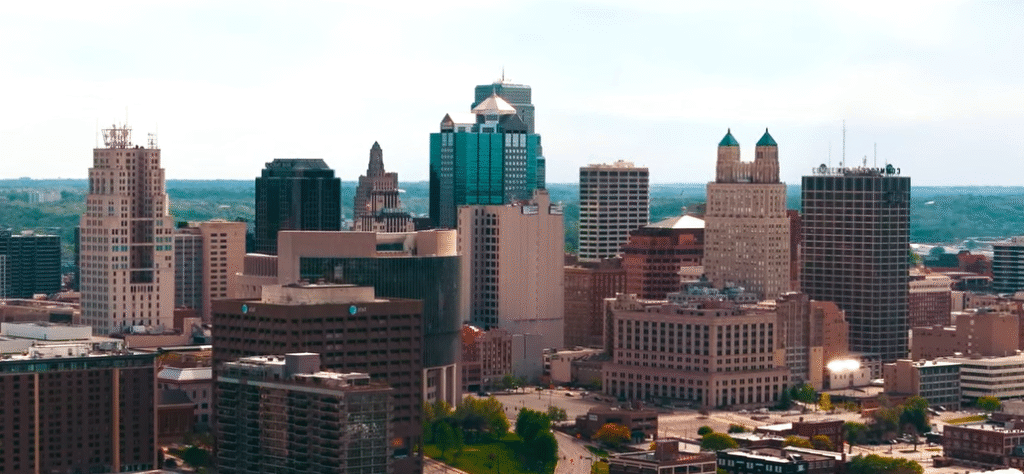
Particularly noteworthy is the context. This was Kansas City, not New York or Chicago. Nevertheless, innovation found a platform thanks to a modest commercial commission from a clothing company. Charles N. Boley had no desire for a traditional office. Curtiss provided him with a structure that danced with light and form, achieving his goal of something remarkably modern and establishing the style for buildings that followed generations later.
Curtiss was motivated by conviction rather than tradition and is frequently referred to as Kansas City’s hidden genius. Curtiss looked up as Frank Lloyd Wright drew echoing prairies and low-slung houses, picturing lofty buildings that hung above sidewalks. The tension between function and artistry was embodied in his work here, and it was resolved with confidence rather than compromise.
Not only did Helix Architecture save an old office building when they restored it in 2009, but they also rekindled an idea. They understood that the building’s DNA contained possibilities in addition to history. Every element, from its wide windows to its delicate cast-iron embellishments, was meticulously restored—not to keep it stuck in the past, but to bring it back into the present.
Today, Andrews McMeel Universal, a creative center that creates some of America’s most extensively syndicated content, is housed in the Boley Building. And that seems especially appropriate. Thinkers, authors, and visionaries continue to shape culture in a place that was once illuminated by innovation.
Kansas City’s architectural soul was once lauded by Brad Pitt, a Missouri native and design enthusiast. This kind of building explains why. They speak instead of merely standing. They question presumptions about who drives design and where it takes place. The ancestry of their glass-and-steel wonders can be discreetly traced back to Walnut Street, even though names like Gehry and Foster predominate in glossy magazines.
Even today, the Boley Building feels especially innovative because it incorporates contemporary materials in ways that no one had previously done. Energy-conscious building projects, LEED-certified developments, and modern offices all reflect its design. Curtiss’s 1909 layout seems not only pertinent but also remarkably progressive in the current movement toward sustainability and daylight optimization.
This building becomes more than just a case study in the context of urban transformation; it becomes a call to action. It challenges cities to examine what was already incredibly intelligent a century ago rather than erasing their past in the name of innovation. Additionally, it is a source of lasting pride for Kansas City.
For many residents, this structure’s emotional impact is very personal. As children, some remember admiring its ethereal windows that glowed in the afternoon sun as they passed it. Others, who are now professionals, enter every day and are still in awe of its exquisite geometry and delicate metalwork. With every look, the building gives back.
Boley provides something very personal in contrast to the expansive Gateway Arch or the magnificent Nelson-Atkins Museum. It doesn’t require notice. Rather, it cultivates love through the little things. Its façade’s rhythm, the iron flourishes’ curve, and the windows’ soft repetition all have a musical feel rather than a mathematical one.
That’s what makes it so beautiful. A lot of the time, great architecture speaks quietly. It doesn’t always extend toward the clouds or sit atop hills. Inscribed into the grid of a city that at last recognizes what it has, it occasionally waits silently.
Students, historians, and designers have come to understand the Boley Building as a starting point rather than merely a relic over time. It served as a model for what architecture could accomplish: combine stability and airiness, beauty and purpose, and civic inspiration with commercial use.
