

People frequently recall a scene from The Karate Kid incorrectly. Adrift in California as a teenager from New Jersey, Daniel LaRusso stands on the bow of a small boat with his arms outstretched and trembling. He’s interested in learning how to punch. Mr. Miyagi desires that he remain upright. “Balance is key,” he says, adding the part that sticks: everything is good, including karate and balance.
Article Details Table
| Detail | Information |
|---|---|
| Film | The Karate Kid (1984) |
| Main Characters | Daniel LaRusso, Mr. Miyagi |
| Actors | Ralph Macchio (Daniel LaRusso), Pat Morita (Mr. Miyagi) |
| Central Theme | Balance in body, mind and daily life |
| Famous Balance Quote | “Balance is key. Balance good, karate good, everything good. Balance bad, better pack up and go home.” |
| Tournament Reminder | “Lesson not just karate only. Lesson for whole life. Whole life have a balance.” |
| Key Training Scenes | Waxing cars, painting the fence, balancing on a rocking boat |
| Related Quote on Foundations | “First learn stand, then learn fly.” |
| Related Quote on Revenge | “You look revenge, that way you start by digging two graves.” |
| Mr. Miyagi’s Background | World War II veteran who lost his wife and child in an internment camp |
| Miyagi-Do Philosophy | Defense over offense, fighting as a last resort, respect even for enemies |
| Sequel Series | Cobra Kai (Netflix, 2018 to 2025) |
| Rival Approaches | Miyagi-Do (restraint and calm) versus Cobra Kai (aggression and dominance) |
| Life Lessons | Patience, discipline, emotional control, humility, strong fundamentals |
| Pat Morita | Passed away before Cobra Kai began; the character appears through Daniel’s memories |
| Modern Relevance | Managing stress, work pressure, anger, and long-term habits |
It’s easy to ignore, and it sounds like a fortune cookie. However, Miyagi never says it’s just about fighting, which makes the line effective. He reminds a terrified Daniel that the lesson is applicable to all aspects of life just before the tournament. More important than any kick in the movie is that moment.
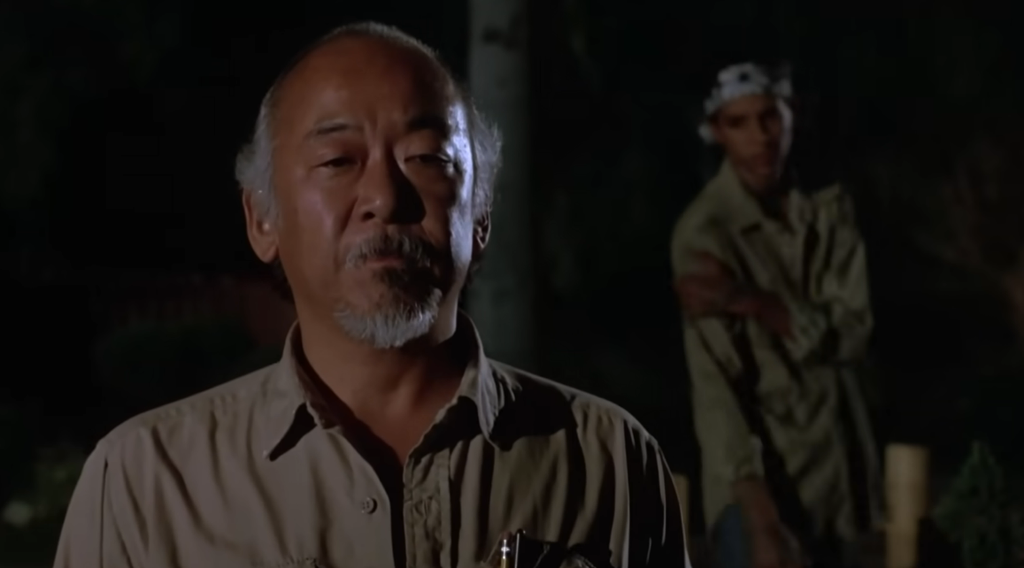
Most of us probably watched for the crane kick and the last fight the first time around. In retrospect, the more subdued moments are more significant. Daniel is sanding a deck. Daniel uses long, worn-out brushstrokes to paint a fence. Daniel’s arms burn as he waxes a row of cars in the sun. Part of the point is that none of it appears to be training. Beneath the skills, Miyagi was developing a body and a mind that could remain composed in the face of chaos.
That could be the reason the movie has endured. Many underdog films from the 1980s concluded with a trophy and nothing more. This one keeps bringing up less glamorous topics, such as patience, repetition, and the notion that you usually lose out when you rush to the exciting part. Miyagi tells Daniel, “First learn stand, then learn fly,” and it’s difficult to come up with a more helpful advice for anyone beginning a new career or craft.
Then there’s the issue of self-control. Although Miyagi is obviously capable of handling himself, he views fighting as a last resort. He informs Daniel that seeking retribution entails excavating two graves. Knowing that he was a war veteran whose wife and child perished in an internment camp while he was serving overseas lends credence to that statement. He’s not giving sermons from a distance. He is aware of the price.
The Netflix series Cobra Kai, which ran from 2018 to 2025, made the debate more complex and truthful. Despite having a family, a car dealership, and a dojo of his own, Daniel’s life continues to go awry whenever an old rivalry resurfaces. It’s difficult to ignore how familiar that feels as you watch it happen. The majority of adults don’t lose their balance in a single, severe fall. One annoyance, one late nite, one resentment at a time, they gradually lose it.
That might be the most useful concept in the movie. You can’t achieve and maintain balance. It’s more akin to Daniel’s continuous minor adjustments on that boat. When necessary, push. Before you break, back off. Talk, then pay attention. To prevent strength from turning into cruelty, combine confidence with a little humility.
This is a legitimate critique. For a two-hour running time and a training montage, a 1984 film can make balance appear straightforward and orderly. You rarely find a clear opponent and a patient mentor in real life. No one on a rocking boat is telling you which way to lean when work, money, family, and exhaustion all pull at once.
The instinct is sound, though. When you start to wobble, pay attention. When things become hazy, return to the fundamentals. Winning the wrong way isn’t winning, so don’t prioritize passion over principle. A maintenance man with a quiet voice and a bonsai tree shares this modest philosophy.
Perhaps that’s why it persists. Even after forty years, the advice is still concise: maintain consistency, continue practicing, and don’t confuse speed with advancement.
