

A coach is currently instructing a disinterested teenager to continue performing the drill. In another place, a senior developer is requesting that a new employee address twenty minor issues before beginning work on the actual project. Neither of them has to give an explanation. Wax on, wax off is all they say.
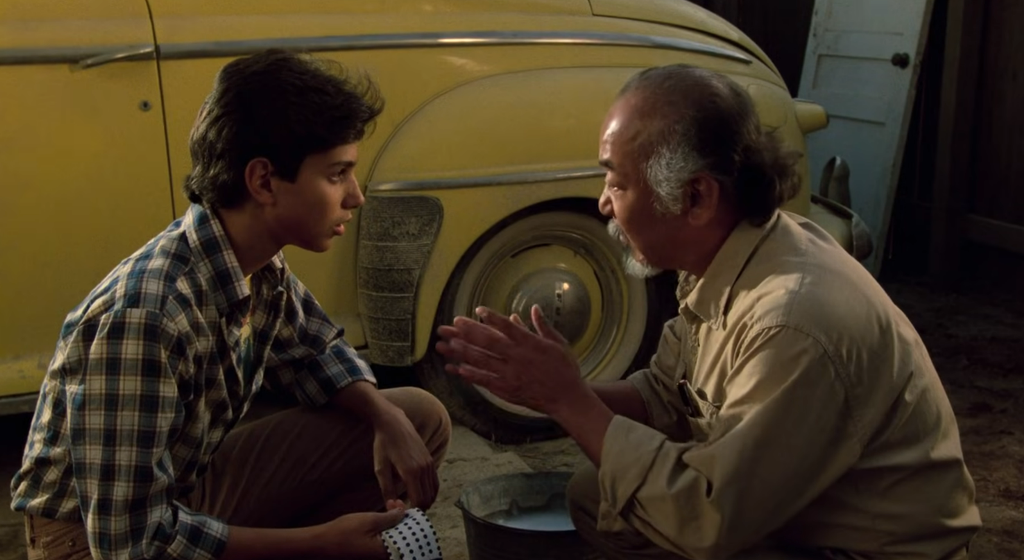
| Detail | Information |
|---|---|
| Phrase | “Wax on, wax off” |
| Origin | The Karate Kid, released in 1984 |
| Writer | Robert Mark Kamen |
| Lead actors | Ralph Macchio as Daniel LaRusso, Noriyuki “Pat” Morita as Mr. Miyagi |
| The setup | Miyagi assigns Daniel chores: waxing cars, sanding a floor, painting a fence and a house |
| Famous instruction | “Wax on, right hand. Wax off, left hand.” Miyagi also reminds Daniel to breathe |
| The reveal | Daniel blocks Miyagi’s punches using the same motions from his chores |
| Core ideas | Muscle (procedural) memory, trust in a mentor, patience, skill hidden inside routine |
| Miyagi’s background | Lost his wife and son in an internment camp and earned the Medal of Honor in World War II |
| Related phrase | “To Miyagi someone,” meaning to teach them without them realizing it |
| Later versions | 2010 remake with Jaden Smith (jacket drill) and the Cobra Kai series |
| Where the phrase shows up today | Sports, music, coding, business and everyday talk about practicing fundamentals |
On paper, the line from The Karate Kid, which was published in the summer of 1984, seems absurd. Daniel LaRusso, a teenager, is interested in learning karate. Mr. Miyagi, a quiet handyman who is his new instructor, gives him a rag and gestures toward a line of old cars. A deck, a fence, and finally a house follow. No kicks, no punches. Daniel acts as a sixteen-year-old would. He becomes enraged.
It’s simple to forget how convincing that rage is. Anyone who has been assigned a seemingly meaningless task by an authority figure understands how it feels. Daniel isn’t exactly being indolent. After doing the math on his own time, he comes to the conclusion that he is being exploited. The payoff occurs in part because the movie gives him time to process that.
Then it does. At last, Daniel loses it and accuses Miyagi of treating him like a slave. Miyagi doesn’t quarrel. He simply tosses a punch, and Daniel’s arm sweeps up to deflect it—the same circular motion he’d made a hundred times on a car’s hood. The training came from the chores. Without realizing it, the child had been learning the entire time.
That is the trick, and it’s a clever one. The reason Miyagi’s teaching is effective is that it never makes an announcement. The type of memory that allows you to type or ride a bike without thinking about your fingers is called procedural memory, and it is developed through repetition. The body instinctively reaches for it when under pressure. It’s debatable whether circular waxing actually results in a clean karate block, and a martial artist would likely cringe. However, the concept endures more than the choreography.
The phrase may have stuck so strongly because it contains a second lesson. Before Daniel could see the point, he had to have faith in someone. Despite losing both his wife and son in an internment camp, Miyagi was awarded the Medal of Honor during the conflict. Talking had not earned him the trust. After just one demonstration, the doubt seemed to vanish from the room.
It’s difficult to ignore how frequently people interpret the phrase to mean something marginally different from what the movie depicts. In gyms and workplaces, it usually means “be patient, the boring part counts.” In the movie, it means something more profound: the dull part only matters if it is led by a capable person. A fence that is painted for no apparent reason is just a fence. The line may sound a bit too reassuring because that distinction is lost.
Culture has continued to reappear. In the 2010 remake, cars were replaced with a jacket, which Jaden Smith hung up and took down until the action became kung fu. Later, the Cobra Kai series experimented with the concept, posing the question of what would happen if the lessons weren’t so gentle. Every retelling implies that the idea remains valid even if the specifics are altered.
Perhaps there is a simpler explanation for why it persisted. The majority of us spend significant portions of our lives engaging in unglamorous activities and questioning whether it all adds up. “Wax on, wax off” is a modest pledge that occasionally comes true. Naturally, there is no guaranty, and Miyagi had the benefit of a script. However, it’s easy to want the promise to come true when you see Daniel’s hand snap up to block that punch.
