

As is always the case with good stories, the plot moves quickly. On the Midwest women’s karate circuit, a young woman from Cicero, Illinois, who is the daughter of a steelworker, has a 71-0 record after training under Walt Brennan since she was eleven years old. Eventually, her opponents cease to appear. She thus requests permission to compete against the men from the tournament committee. Reluctantly, they consent. She doesn’t give up a single point in nine fights. Then Bruce Lee appears in some way. 16mm film canisters concealed. a microphone. There were five thousand people present. History, forgotten for more than fifty years.
It’s an interesting tale. The kind of tale that compels you to believe it. In late 2026, the videos promoting the Diane Novak karate story received hundreds of thousands of views on Facebook and YouTube. The AI-generated images of a woman in a gi, spotlights, and vintage tournament halls that appear sufficiently authentic are featured in the dramatic thumbnails. The narration is confident and well-practiced, the kind of voiceover delivery that tells your brain it’s “documentary” before you’ve had a chance to consider whether the underlying facts make sense.
The problem is that they don’t for the most part. It is nearly impossible to find Diane Novak in the actual history of American karate. Even basic details are a source of disagreement among the viral accounts; some place the crucial tournament in 1970, while others place it in 1971. Between retellings, Bruce Lee’s involvement is described differently. None of the main assertions have been supported by verified tournament archives, modern newspaper reports, photographs, or reliable witnesses from the martial arts community of that time.
The only known reference to a “Diane Novak” in relation to competitive karate is a brief note from an article published in the Akron Beacon Journal in 2004. It states that a person by that name finished second in a division at a regional karate tournament, which is an entirely normal result with no indication of anything noteworthy going on.
Beneath all of this, there may be a glimmer of something genuine: a woman who participated seriously in a sport that at the time mostly disregarded women, whose tale was appropriated, exaggerated, and dramatized to the point of becoming unrecognizable.
That would not be out of the ordinary. Genuine female martial arts pioneers emerged in the 1960s and 1970s, but their stories are still little known because the sports media of the time seldom gave them much attention. It’s important to keep in mind that actual history is frequently misrepresented and lost, and that the lack of a record does not always equate to the absence of an event.
However, lost history and invented history are two different things, and the Diane Novak karate videos fall much closer to the latter. The imagery produced by AI is a dead giveaway. The format is also the same; every video has the same dramatic beats, the same emotional arc, and the same build-up to a confrontation with Bruce Lee that was fortuitously captured on camera but never made public until a YouTube channel chose to post it.
Recovered history does not have these characteristics. They are the distinguishing characteristics of content created to thrive on a platform that prioritizes emotional engagement and viewing time over accuracy.
Exactly none of this is new. Bruce Lee’s viral mythology has long been a cottage industry. His true legacy is so rich that it probably doesn’t need to be embellished. He was a martial artist, a movie star, and a truly unique thinker about philosophy and combat. However, the embellishment never stops, and Diane Novak is the most recent example.
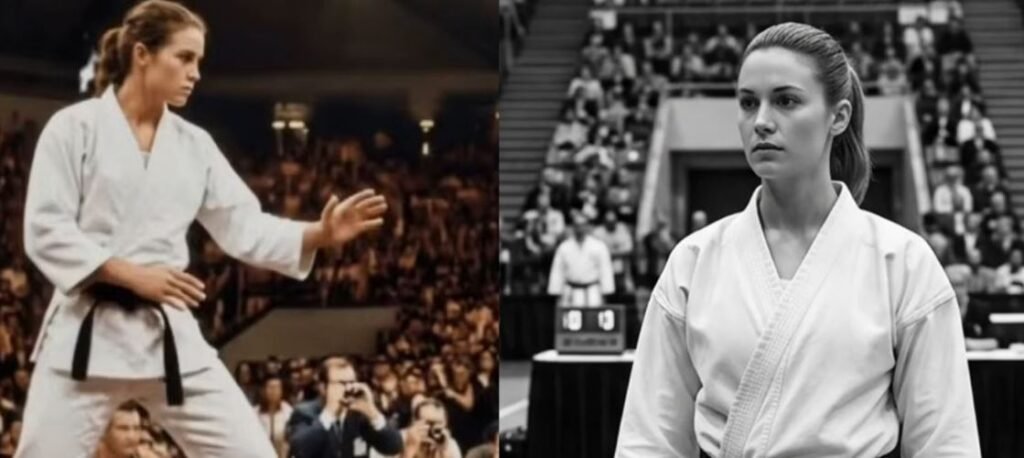
There’s a feeling that the creators of these videos are aware of a reality about their audience: because the story is emotionally fulfilling, viewers want to think that women were accomplishing amazing things in places that refused to recognize them. In the past, it’s also frequently true. In the 1970s, women were performing incredible feats in karate circuits throughout the Midwest. Just not necessarily these things, in this manner, with this specific individual.
Amid all the cacophony, the story raises a valid question that is worth preserving. During that time, women did participate in competitive martial arts, and the obstacles they encountered were real. When the majority of the organized competition scene treated female athletes as an afterthought, instructors like the fictional Walt Brennan in this story actually existed as a type—men who trained women seriously. Without artificial intelligence narration and fake film canisters, those stories ought to be located and presented appropriately.
The viral phenomenon of Diane Novak karate reveals more about the desires of viewers than it does about the actual events that took place in an Illinois tournament gymnasium fifty years ago. That hunger is justified. The narrative as it is told is not.
