

When you find out that someone who improved the lives of millions of people was secretly disintegrating, a certain kind of sadness sets in. After spending time with the memories of those who truly knew Noriyuki “Pat” Morita, one gets the impression that he was a more complex, multifaceted person they met in green rooms, on movie sets, and over lengthy lunches where the cameras never followed.
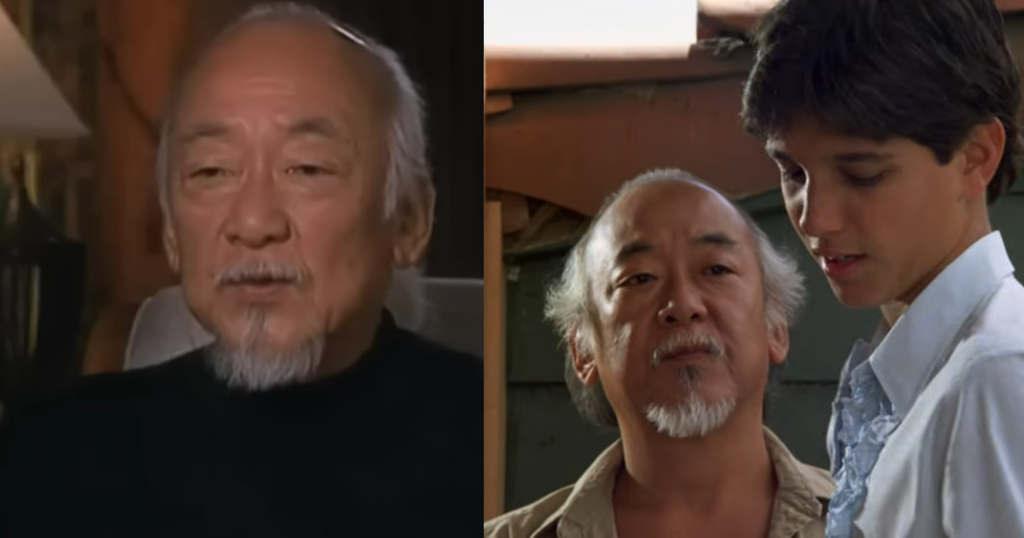
The son of Japanese immigrants, Morita was born in Northern California in 1932. His early years were characterized by the kind of adversity that would define nearly everyone who survived it. He was hospitalized as a young child due to spinal tuberculosis, and by the time he recovered, America and Japan were at war. He and his family were sent to an internment camp, which he once referred to simply as a concentration camp, rejecting the more diplomatic nomenclature that history had chosen. He emerged from that experience with a keen sense of humor and, it seems, an equally keen awareness of the opinions of others who shared his appearance.
A writer who collaborated with Morita, Mark Evanier, recalled that he was acutely aware of the few roles available to Asian actors, but he never allowed that awareness to turn into resentment in public. He described Morita as “a delight to work with” and pointed out that despite Hollywood offering him roles that hardly went beyond the stereotype, the man never took his money or his platform for granted. It’s possible that the humor served as a survival tactic in part, allowing him to navigate a room, an audition, and a decade on his own terms when there weren’t many other options available in the industry.
In retrospect, that portion of the story tends to be flattened because his stand-up career came first. Before television called, Redd Foxx, whose own journey through comedy clubs had been equally difficult, saw something in Morita and supported him. In the 2021 documentary More Than Miyagi, director Kevin Derek used archival footage of the stand-up performance to show a performer who used genuinely sophisticated timing to subvert racial stereotypes. He was doing something more intentional than simply making audiences laugh. From the outside, it didn’t always appear that way.
After Happy Days gave him Arnold, the face became well-known to millions of people. However, the 1984 film The Karate Kid’s leap to Mr. Miyagi nearly failed. Producers were reluctant to view him as a dramatic anchor because of his comedic reputation, which had kept him employed for years. Ralph Macchio, who was just out of his teens when the movie was shot, has expressed opinions about Morita that go beyond simple admiration. The camaraderie they developed on set continued into Macchio’s subsequent work on Cobra Kai, where he was adamant from the start that the show should respect Miyagi’s legacy rather than avoid it. That insistence is subtly telling; it’s the kind of thing you do when someone is important to you on a personal level as well as a professional one.
| Full Name | Noriyuki “Pat” Morita |
| Date of Birth | June 28, 1932 |
| Place of Birth | Northern California, USA |
| Date of Death | November 24, 2005 |
| Place of Death | Las Vegas, Nevada, USA |
| Age at Death | 73 |
| Early Health Challenge | Spinal tuberculosis; hospitalized for years as a child |
| WWII Experience | Sent to a Japanese American internment camp |
| Career Start | Stand-up comedian |
| Early Mentor | Redd Foxx |
| Breakthrough TV Role | Arnold Takahashi on Happy Days |
| Iconic Film Role | Mr. Miyagi in The Karate Kid (1984) |
| Academy Award | Nominated for Best Supporting Actor for The Karate Kid |
| Karate Kid Co-star and Friend | Ralph Macchio |
| Documented Personal Struggle | High-functioning alcoholism (revealed by wife Evelyn Guerrero) |
| Third Wife | Evelyn Guerrero Morita |
| Documentary About His Life | More Than Miyagi: The Pat Morita Story (2021), directed by Kevin Derek |
| Documentary Contributors | Ralph Macchio, William Zabka, Henry Winkler, Martin Kove, James Hong, Marion Ross, Tommy Chong, Esai Morales, Sean Kanan, Anson Williams, Don Most |
| Legacy in Cobra Kai | Ralph Macchio insisted the show center on Miyagi’s spirit from the start |
| Cultural Contribution | Helped pave the way for Asian-American representation in Hollywood |
The lengthy and diverse list of individuals who consented to be interviewed for the documentary—including William Zabka, Henry Winkler, Martin Kove, Tommy Chong, James Hong, and Marion Ross—says something in and of itself. Even in a supporting role, Morita left an impression, according to Winkler, who co-starred with him as Fonzie on Happy Days. The documentary’s most honest content came from Evelyn Guerrero, Morita’s third wife, who described a man with a genuine warmth and work ethic who was, by the end of his life, a high-functioning alcoholic who was rarely completely sober even on set. He did a good job of hiding it, she says. Despite what they now knew, almost everyone seemed to agree that they couldn’t bring themselves to speak poorly of him.
At the age of 73, he passed away in Las Vegas on November 24, 2005. The Karate Kid’s Oscar nomination never produced the roles it might have. However, those who watched him perform for a comedy club audience in his early years, sat across from him at a table, or shared a set with him for months describe someone who continued to show up with generosity and humor even when his own life was quietly falling apart. That is not a minor issue. In actuality, it’s the entire tale.
