

Li Fong is a character that is difficult to forget. In Karate Kid: Legends, he appears with more weight than a fighting stance: grief, guilt, a promise to a bereaved mother, and the burden of a brother who failed to return home. Because of this combination, he is one of the franchise’s most complex protagonists in recent years, and a single viewing doesn’t fully reveal a lot of his depth.
The most remarkable thing about Li Fong is that his martial arts career did not start in New York. It started in Beijing under the guidance of Mr. Han, who turns out to be more than just a teacher but also his great-uncle. He spent years training with his older brother Bo, developing a foundation in Kung Fu that would have prepared both of them for serious competition.
Things quickly became ugly after Bo won a significant tournament. After that, the brothers were ambushed by a vengeful opponent and his group, and Bo was killed while Li froze. Throughout the entire movie, Li is plagued by that moment of paralysis, which appears more as a psychological injury than as a plot device.
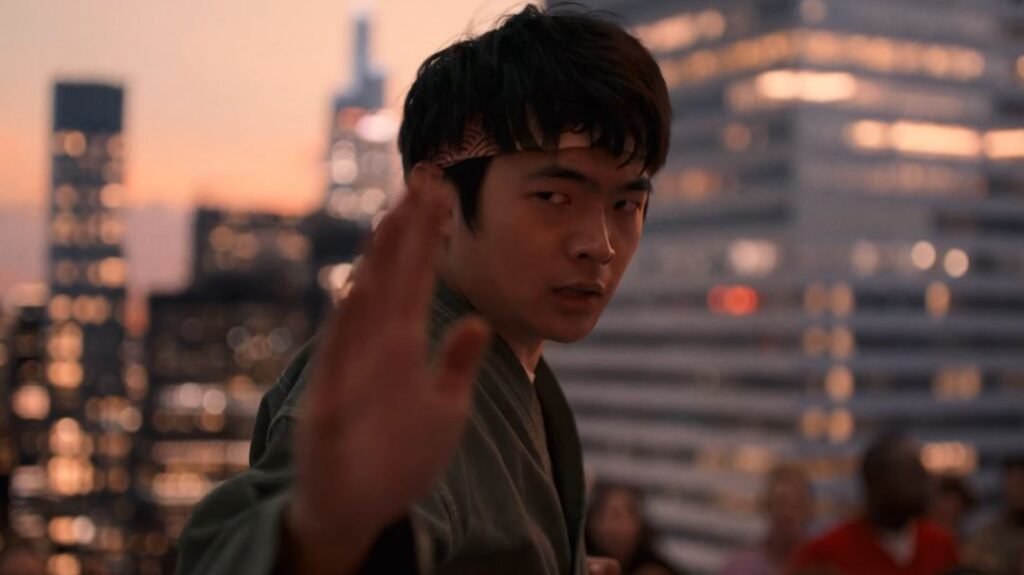
In reaction to the tragedy, his mother outlawed kung fu completely. not merely put it on hold. Delete it. The family was moved from Beijing to New York City by Dr. Fong, portrayed with genuine conviction by Ming-Na Wen, and it was made clear that there would be no more fighting. Li is intriguing because he genuinely makes an effort to honor that pledge. He’s not trying to find an excuse to fight. Nevertheless, Connor Day, a local karate champion and former boyfriend of Mia Lipani, who was the first person to truly show Li kindness in a strange city, finds him in the fight.
In the history of the franchise, the training that ultimately leads Li to return to martial arts is truly unique. He doesn’t merely pick up kung fu again. He rebuilds his kung fu under Mr. Han while learning Miyagi-Do Karate from Daniel LaRusso, the original Karate Kid who is now an experienced instructor. The end effect is a hybrid look that is more earned than practical.
His fighting style is characterized by two particular techniques: the One-Inch Punch, which is derived from close-quarters kung fu tradition and produces explosive impact without the telegraphing of a large wind-up, and the Tiger Trap, a counter move intended to lure aggressive opponents into a vulnerable position mid-air. These aren’t merely artistic flourishes. They show a true fusion of philosophies, which is what Li’s arc is all about.
The actor responsible for all of this has something noteworthy to say. Given how much of Li’s identity is based on juggling two cultural worlds at once, Ben Wang’s fluency in both Mandarin and English is more significant than it might seem.
Furthermore, Wang entered the position with a strong background in martial arts, including taekwondo, wing chun, karate, kenpo, and kumdo. You don’t create that list for a film. The fight scenes feel more realistic than the typical Hollywood approximation, which is likely due to years of actual work. Additionally, he received the Star of Tomorrow award at CinemaCon 2025, indicating that the industry was paying attention to more than just the stunt choreography.
It’s worth paying close attention to the Five Boros Tournament, where Li eventually takes on Connor. At one point, Connor leads 4-0, and Li’s comeback is methodical rather than dramatic. He recognizes Connor’s patterns, modifies his timing, and employs the Dragon Kick as bait—a purposeful setup for the Tiger Trap—rather than to win outright. It’s a clever narrative device inserted into a battle scene. Connor is not overpowered by Li. He thinks better than he does.
After watching Li Fong’s story, a more subdued question remains: did martial arts save him, or were the people around him—Mia, Victor, Mr. Han calling from all over the world late at night—the ones who truly saved him? It might have been both. More than any tournament trophy, Li Fong is worth discussing because of that ambiguity.
