

After sailing across the South Pacific for five days, the Marin Mainiku anchored off the coast of Nikumaroro Island on a Monday in October 2026. The 17-person crew, which included researchers from Purdue University and the Archeological Legacy Institute, had traveled about 830 nautical miles to examine a shape that was perched at a lagoon’s edge. They would remain on the ship at nite. Giant coconut crabs, whose overnight activity makes staying on the island impractical, are the reason, as stated clearly in the expedition blog.
TABLE
| Field | Detail |
|---|---|
| Subject | Amelia Earhart’s disappearance and its connection to Nikumaroro Island and coconut crabs |
| Earhart’s disappearance date | July 2, 1937 |
| Co-pilot | Fred Noonan |
| Flight mission | Around-the-world attempt; disappeared en route to Howland Island from Lae, Papua New Guinea |
| Official U.S. government position | Plane ran out of fuel and crashed into the Pacific Ocean |
| Alternative theory | Earhart and Noonan landed on Nikumaroro Island and survived as castaways |
| Island | Nikumaroro, Kiribati — uninhabited Pacific atoll |
| Object under investigation | The “Taraia Object” — unidentified shape spotted in 2020 satellite imagery and 1938 aerial photos |
| Current expedition (2026) | Purdue University & Archaeological Legacy Institute — 17-member team, 5-day fieldwork |
| Voyage distance | ~830 nautical miles / 1,500 km across the South Pacific |
| Ship name | Marin Mainiku |
| Expedition leader | Rick Pettigrew |
| Coconut crab (Birgus latro) | World’s largest land crustacean; spans up to 1m tip to tip; can lift ~28–30 kg; nocturnal scavenger |
| Bone dispersal experiment | 2018 study using pig carcasses — crabs consumed flesh and scattered bones within two weeks |
| 1940 bone discovery | Human remains found on Nikumaroro; originally identified as male; later lost before modern forensic testing |
| 2018 forensic study | Concluded original sex assessment was likely incorrect; bones “strongly supported” belonging to Earhart |
| Items previously found on island | Cosmetic jar fragment, aircraft-related materials, part of a shoe |
| Skeptic position | Ric Gillespie (competing Earhart researcher) — believes Taraia Object is a tree, not aircraft wreckage |
| Crab safety concern | Team slept aboard ship nightly due to coconut crab population size and nocturnal activity |
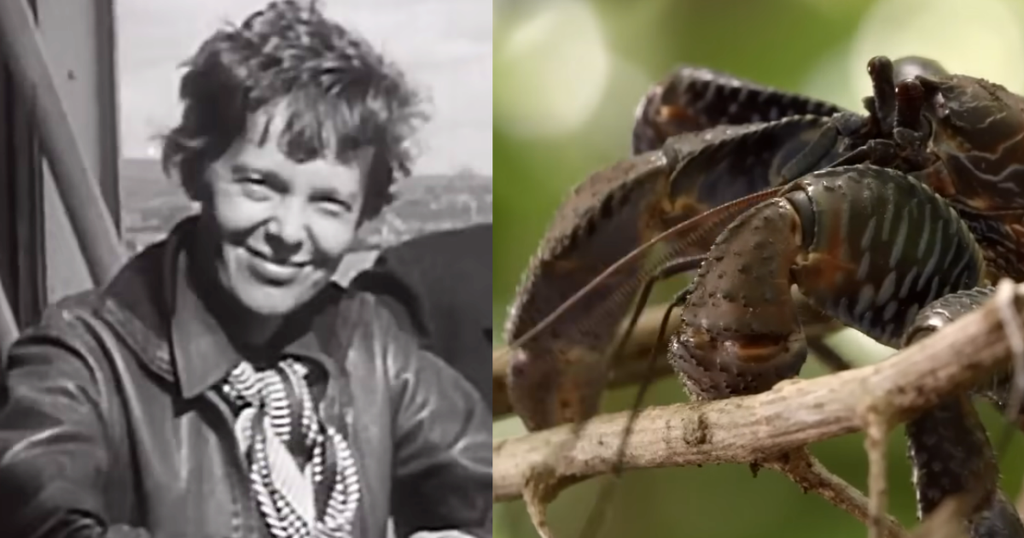
You can learn something about the location just from that detail. Although Nikumaroro is not inhabited by humans, it is heavily populated. The largest land-dwelling crustacean in the world is the coconut crab, or Birgus latro. It can climb trees, lift about 28 kg, crack open a coconut with its claws, and span a meter from tip to tip. It scavenges practically anything left on the ground while hunting at nite. There are many of them on Nikumaroro.
The Taraia Object, an unidentified shape first seen in satellite imagery in 2020 and visible in aerial photos dating back to 1938, is the object the researchers came to investigate. Some speculate that it might be a component of Amelia Earhart’s Electra. Others are openly doubtful, such as rival explorer Ric Gillespie. “The root ball is visible. The branches are visible. It’s a tree. He told Reuters, “People see what they want to see.” It’s still unclear if the team will find anything definitive, and to be honest, that uncertainty seems reasonable considering the history of Earhart searches.
On July 2, 1937, Amelia Earhart and her navigator Fred Noonan disappeared while trying to fly around the world. The official U.S. government has always maintained that the plane crashed in the Pacific Ocean after running out of fuel. However, a competing theory maintains that Earhart and Noonan made an emergency landing on Nikumaroro and survived for a while as castaways. This theory is persistent and detailed enough to continue attracting expeditions to this remote atoll. The crabs entered the picture after that.
To find out what the coconut crabs would do, researchers put pig carcasses on the island in 2018. The results were startling: in less than two weeks, the crabs dispersed bones over a large area and quickly devoured soft tissue. The experiment did not specifically prove anything about Amelia Earhart, and it was not subjected to peer review. However, it provided a convincing explanation for a problem that has always plagued investigators: why so little of a skeleton was ever found if someone died on this island. Before contemporary forensic testing could be performed, human remains discovered there in 1940 were examined, identified as male at the time, and then lost. According to a 2018 forensic anthropology study, the bones were more in line with a woman of Amelia Earhart’s measurements, challenging the initial sex assessment.
People seem to be drawn to this story not only because of Amelia Earhart’s notoriety but also because the island itself is so peculiarly particular—the broken shoe, the materials connected to the aircraft, the piece of cosmetic jar, etc. It’s all not conclusive. It’s all suggestive. It’s possible that Earhart perished in the ocean, that the bones discovered in 1940 belonged to someone else, and that the Taraia Object is actually a fallen tree. That could be the most likely response. However, it is hard to ignore the fact that the same tiny atoll continues to produce pieces that fit the same narrative. As of this week, researchers are once again using machetes to hack through its jungle, sleeping offshore due to crabs, and searching for a plane that vanished almost nine decades ago.
The expedition anticipated spending five days on the island. It remains to be seen if that will be sufficient time to discover anything significant or to finally close a chapter that aviation history has left open for almost a century.
