

There is a moment in the first season of Cobra Kai where Daniel LaRusso round-kicks a boba tea out of a competitor’s hand — in the man’s own dealership showroom, in front of customers — because he felt insulted by a joke. It is a small scene. Played partly for laughs. But it lodges itself in the memory, because it does not look like something a hero does. It looks like something a guy with unresolved anger does, wearing the clothes of a successful adult who has mostly fooled himself about the kind of person he is.
The question of whether Daniel LaRusso is the bad guy is one of those internet debates that seems absurd on the surface and then, the longer you sit with it, starts revealing something genuinely interesting about storytelling and perspective. The original theory — that Daniel, not Johnny, was the real antagonist of the 1984 film — gained traction through a viral YouTube video and was later popularized by a running joke on How I Met Your Mother. The argument goes that Daniel provoked Johnny repeatedly, that the famous Halloween hose prank was unprovoked, that the crane kick may have been an illegal strike. These are not frivolous points.
But they are also incomplete ones. What the theory tends to skip over is the sustained, physical harassment that preceded most of Daniel’s reactions. Johnny and his friends trashed Daniel’s bicycle. They cornered him at a Halloween dance and beat him badly enough that Mr. Miyagi had to physically intervene. The idea that Daniel was the primary aggressor in that dynamic requires ignoring a fair amount of what actually happened on screen.
For most of the original film, Johnny is genuinely the antagonist. The real villain, if one must be chosen, is John Kreese — the man who instructed teenagers to injure their opponents and who shaped Johnny’s cruelty long before Daniel arrived in the valley.
Cobra Kai complicates all of this, which is exactly what makes it worth watching. The show opens with Johnny’s life in ruins and Daniel’s thriving, and it invites the audience to reconsider who deserved what. An older Daniel is short-tempered, self-righteous, and at times almost petty in his determination to shut down Cobra Kai. He convinces a landlord to double rent on an entire strip mall just to drive Johnny out. He shows up to an All-Valley committee meeting to defame a rival dojo based on events from thirty years ago. These are not the actions of a man who has fully outgrown his grudges.
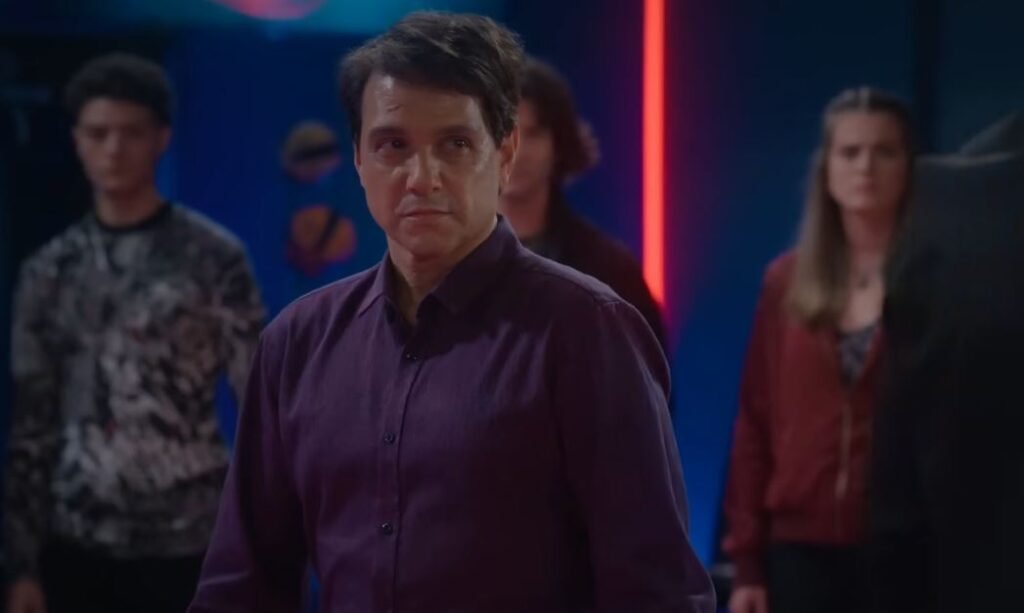
There’s a sense, though, that labeling Daniel a villain misses the more nuanced point the show is making. He is not malicious. He is not calculating. He is stubborn, emotionally reactive, and convinced of his own righteousness in ways that occasionally blind him to legitimate counterarguments. What is interesting is that his fears about Cobra Kai’s toxicity ultimately prove correct — Kreese does take over, Silver does corrupt the students, the violence does escalate exactly as Daniel warned it would. Being right does not excuse every method, but it complicates the villain label considerably.
What Cobra Kai does best is refuse to assign clean moral categories to anyone who was involved in those original conflicts. Both Daniel and Johnny were shaped by things they did not fully choose — absent fathers, difficult schools, teachers who modeled the wrong lessons. By the later seasons they are, slowly and imperfectly, working through that. They become something close to friends. They fight alongside each other. There is something quietly affecting about watching two men in their fifties finally stop rehearsing a fight from high school.
Daniel LaRusso is not the bad guy. But he is not quite the uncomplicated good guy either. He is a flawed person who spent a long time mistaking his grievances for principles. Most interesting characters are something like that.
