

Reactions to the 2010 Karate Kid remake, which was set in Beijing and starred Jaden Smith learning kung fu from Jackie Chan’s Mr. Han, were largely divided along generational lines. The movie had very little to do with karate, as older fans pointed out, sometimes loudly.
Younger audiences were unconcerned. With a global box office total of $343 million, the film presented Chan’s Mr. Han as a subtly captivating mentor figure who was soulful in a way that felt truly earned rather than appropriated from Pat Morita’s legacy.
The announcement of a sequel starring Jaden Smith was followed by a covert shelving and another announcement. At one point in 2014, Breck Eisner was attached to direct. Scripts went around. Nothing shifted.
The 2010 movie was commercially successful and emotionally appealing to a particular generation, but it was officially cut off from both the original Karate Kid universe and the Cobra Kai series, which had brought Ralph Macchio and William Zabka back into the franchise, for roughly ten years.
The result of that protracted wait is Jonathan Entwistle’s Karate Kid: Legends, which was released in May 2025. It is not, in the conventional sense, a follow-up to the Jaden Smith movie. There is no sign of Jaden Smith. The plot centers on Ben Wang’s character, Li Fong, a Beijing-born kung fu prodigy who relocates to New York following a family tragedy and ultimately competes in the Five Boros tournament.
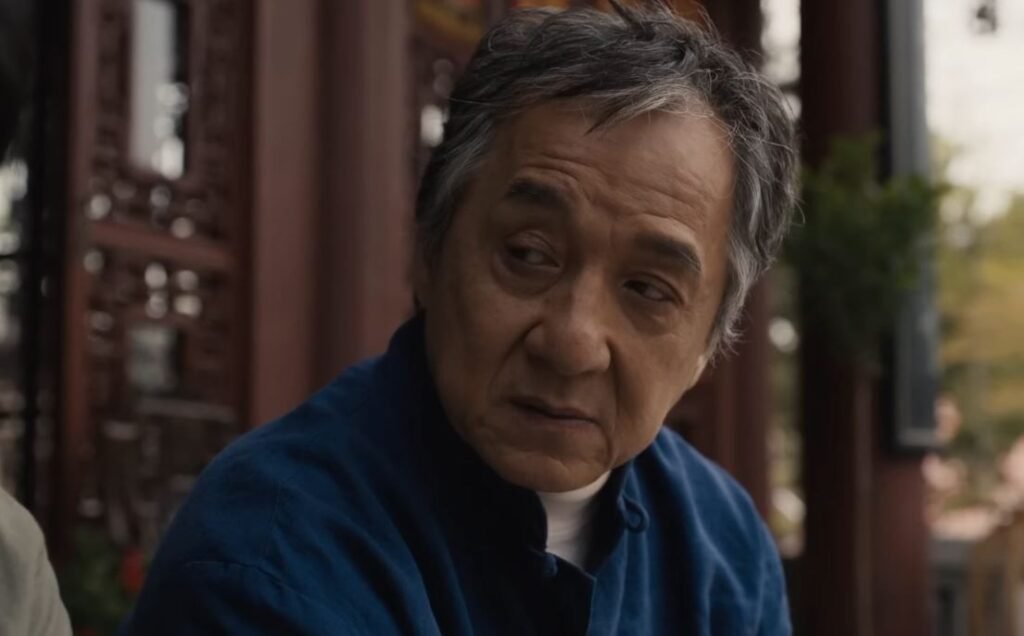
The fact that Mr. Han and Daniel LaRusso appear to train him—Jackie Chan reprising his 2010 role, Macchio reprising his from the original trilogy, and Cobra Kai—ties it to the broader franchise. The franchise had been considering a crossover for fifteen years without making a commitment until the two characters finally met on screen.
Without being hurried, the setup is effective. After the family moved to New York, Li’s mother forbade him from practicing martial arts because his older brother Bo was killed following a tournament victory gone wrong—a rival’s retaliation.
Nearly instantly, he betrays that promise and gets into a fight with Conor Day, a local karate champion whose sensei has financial power over a pizza shop owner Li has made friends with. It is structured like a traditional Karate Kid: a new kid, an unlikely community, an antagonist who is supported by an adult puppet master, and a final tournament. This template has always worked well for the franchise, and Legends stays true to it.
The texture surrounding Mr. Han’s appearance is new. After learning that Li has returned to martial arts, he leaves Beijing for New York and then travels to Los Angeles expressly to ask Daniel LaRusso for assistance.
The most intriguing part of the movie is that scene where Chan shows up at Macchio’s dojo and they discuss how to train the same child using two different fighting traditions. Different philosophies are quietly acknowledged without being oversimplified. Both mentors modify Li’s signature move, a spinning kick known as a dragon kick that he learned from his late brother. The point is the combination.
With a $45 million budget and a $117 million global box office total, the movie is a modest but real success for Sony. Critics’ opinions were more divided; a 57% rating on Rotten Tomatoes reflects a common grievance that the plot follows well-known beats but falls short of creating the emotional impact of the franchise’s best movies.
That’s a reasonable interpretation. Joshua Jackson does something intriguing with a role that could have been merely functional, Ben Wang is captivating, and Ming-Na Wen offers genuine warmth as Li’s mother. However, the script moves quickly rather than deeply.
Watching Legends feels like it’s doing two things at once: it’s a stand-alone narrative for new viewers and a touching moment for those who’ve seen everything from the 1984 original to all six seasons of Cobra Kai. For the most part, it controls both.
The final scene, in which Li delivers Daniel a frozen pizza while he and Johnny Lawrence argue over whether California or New York pizza is better, has the kind of effortless warmth that the franchise excels at when it isn’t trying too hard.
A 70-year-old Jackie Chan gives Mr. Han a unique quality that a younger version of the character couldn’t. His performance has a stillness that coexists with the sporadic physical moments without making an effort to achieve them. It’s difficult to ignore how much has changed since 2010 and how successfully it has persisted.
