

The best tennis player in the world almost lost to someone he’s beaten every time they’ve played. It was both awkward and interesting to watch. Alexander Zverev came to Arthur Ashe Stadium as the No. 1 seed, having just won his first Grand Slam title at Roland Garros. This weight doesn’t just come from being the number one seed, though. He looked like he wasn’t sure how to carry it for about five hours, until about 2 AM New York time.
No one ranked Lorenzo Sonego even close to Zverev, and he came into the match with a 1-9 record against top-10 players in Grand Slams. But Sonego played like that didn’t matter. He was a wall. Not a fancy one. Just always, quickly, and annoyingly good at being where they need to be. During the match, Zverev had 22 chances to break. Five goals were scored. Being stuck at the bottom of the stat sheet, that number tells you almost everything you need to know about how the nite went.
The first set was pretty easy: Zverev won 6-4 and looked like the player who dominated the tournament in Paris. Sonego then found his range. The Italian won the second set, and Sonego won the third in a tiebreak. Zverev was now down two sets to one and only two points away from an early exit that would have changed the history of the US Open. At Flushing Meadows, no No. 1 seed for men has ever lost in the first round. There was a bad view from where Zverev was standing on the edge of that cliff.
In times like these, it’s easy to forget how hard it is to play tennis late at nite at a major. The lights at Arthur Ashe don’t pop and dim. The noise doesn’t go away. During the third set tiebreak, Zverev looked clearly irritated. He was feeling a lot of tension, the kind of tension that can either make a player better or worse. There’s a chance that the real test of the nite was having to deal with frustration instead of giving up.
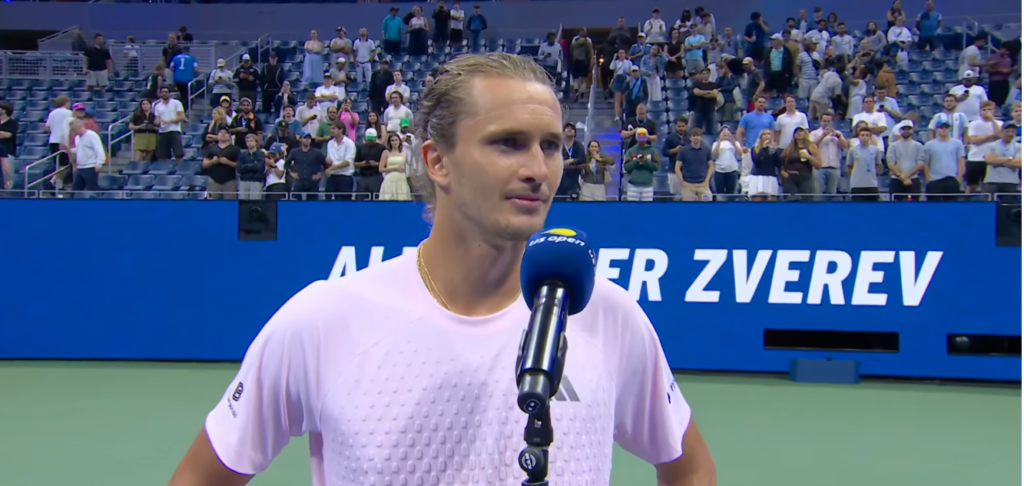
In the end, he got through. After an early break in the fourth set, Zverev cupped his ear to the crowd. It didn’t look like he was celebrating, but more like he was trying to convince himself that he was still in it. After that, he missed three more break points. Sonego was there. The momentum changed direction again, just like it did all nite. It’s still not clear if Zverev ever really took control or if Sonego’s hurt right wrist (which required a medical timeout in the fifth) finally gave Zverev the space he needed but couldn’t get on his own.
With a score of 6-4, Zverev won the fifth set. Four hours and fifty-two minutes were spent on the match in total. The top seeds are now 11-0 in five-set first-round Grand Slam matches. Ivan Lendl beat a top seed in five sets in the first round of the US Open in 1988. Which is the last time this happened. Zverev’s name is now next to that footnote, which isn’t exactly where the Roland Garros winner and new No. 1 seed wants it to be after the first round.
When the match was over, Zverev was kind and calm. He gave Sonego credit. He agreed that it was hard. He said something that stuck with me: winning Roland Garros didn’t make the hunger go away; it made it stronger. “Once you win one, you want to win more.” That makes you think that Zverev really believes that. But having faith and putting it into action are two different things. Tuesday nite showed the difference between them more clearly than any press conference could.
It remains to be seen if this almost disaster makes him tougher for the later rounds or if it showed something more consistent about how he handles pressure. But one thing is for sure: Sonego gave him a lot more than anyone expected, and Zverev made it through—not easily or cleanly, but enough.
