

There’s a moment when you see truly new technology work for the first time. I don’t mean faster processor or slicker app, but new in the sense of “why didn’t someone think of this before?” and it stays with you. That’s how Dyson’s CameraJet toothbrush makes you feel.
The CameraJet was shown off by James Dyson in Paris on September 1, 2026. It is not a toothbrush in the usual sense of the word. It’s a camera, a throat spray, a mouthwash dispenser, and a brushing coach all in one. You hold it up to your bathroom mirror every morning. There is a good reason to wonder if it is worth the price. But what Dyson has built here is more difficult to dismiss than the doubters might think.
Most people are aware of a problem but rarely do anything about it. This is where the main idea comes from. Dyson’s research shows that 90% of people don’t floss regularly and that most people only brush their teeth for 45 seconds, which is much less time than the two minutes dentists recommend. It’s easy to miss the spaces between your teeth, but that’s exactly where plaque builds up. Dyson didn’t just make a louder, stronger toothbrush as a response. It took six years, 661 engineers, 30 dentists, and 38 patents for the company to work on this. That’s the kind of number that makes you look twice.
A 100,000-pixel macro lens camera that runs what Dyson calls “Gap Optical Targeting” is in the middle of the device. Machine learning is used to look at 28 live images every second and find the gaps between your teeth in real time. As soon as it sees one, it sends a precise burst of mouthwash straight into the space within 100 milliseconds. There are 16 million lines of code that make the system work. It learned from 470,000 pics of teeth. Those are really strange numbers for a toothbrush.
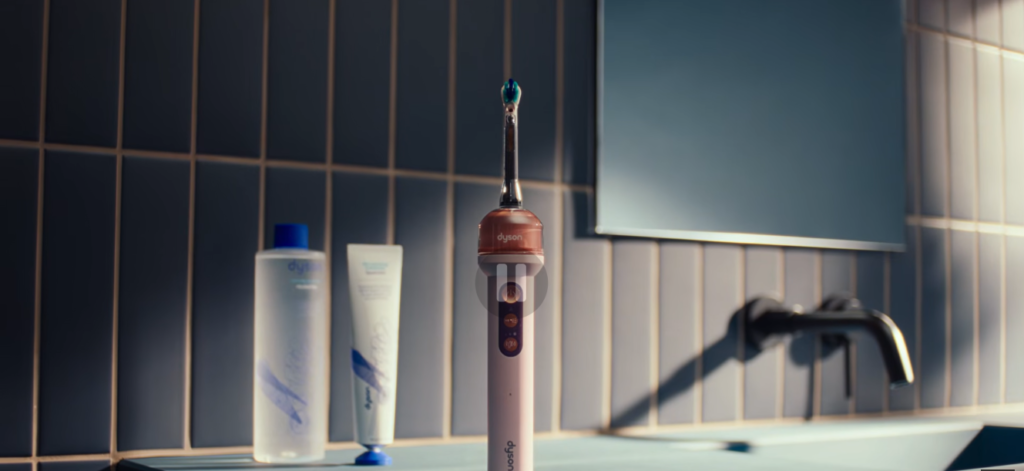
The jet itself is interesting to learn about. A narrow, needle-like stream is used by most water flossers. During tests, Dyson’s engineers found that this method could cut through plaque without cleaning up the area around it. So, the company made a conical jet instead, which has a wider area of coverage, lower pressure, and is meant to sweep instead of pierce. The system can get rid of a lot more plaque in hard-to-reach places than the best sonic toothbrushes, according to tests done with the National University of Singapore’s Faculty of Dentistry. Dyson even made a fake plaque just for the development process, so engineers could test and improve the jet over and over again in a controlled environment.
The brush head has also been changed. Engineers at Dyson looked at slow-motion videos of regular sonic toothbrushes and saw that the bristles can stop moving when they are pressed flat against a tooth. When the CameraJet brushes, it changes the angle of movement by using variable sonic oscillation. Dyson makes it clear that teeth are not flat, which is why the head is shaped instead of flat. The inner bristles are firmer and clean the surface, while the outer bristles are softer and work on the gumline. A RFID tag inside each head lets the toothbrush keep track of how often it is used and let you know when it’s time to replace it.
This is something that many people don’t know: you can see what the toothbrush sees. The camera sends a live picture to your phone while you brush your teeth when you use the MyDyson app. Dyson says it’s like looking through a dental endoscope. The app also gives you feedback on your technique, helps you clean, and maps out your coverage. It’s been made clear by Dyson that the camera only works when live viewing or auto-jetting mode is turned on. Because of what the camera is doing, there are no pictures taken or saved on the device or in the cloud. This is a privacy issue that should be brought up right away.
You can now buy the CameraJet in Ceramic Ultra Blue and Ceramic Pink for $499. It comes with two brush heads, a charging dock, a charging cable, and a travel case. Dyson has also made its own toothpaste that doesn’t foam and a mouthrinse with sodium fluoride, phosphates, and xylitol that is meant to work with the precision jet. Both of these products are made without SLS so that the camera can see clearly.
That’s a lot. It’s not possible to act otherwise. Watching this technology work, though, makes you think that Dyson has done more than just put a camera on a consumer product and call it smart. It doesn’t look like the old way of brushing is broken until something like this comes along and shows you what you’ve been missing.
