

When you first look at the picture, it seems almost silly. An astronaut, wearing a space suit and working carefully inside a portable glovebag, holds a small sample pouch that doesn’t hold a piece of cutting-edge technology or a biological specimen. It holds cement. Simple, old, and completely normal cement. While Alexander Gerst was on the International Space Station, he was doing something very out of the ordinary for the European Space Agency.
MICS, NASA’s Microgravity Investigation of Cement Solidification, looked at how cement hardens, which is something that builders on Earth have used for thousands of years. What’s interesting is that no one had really looked into what that process looks like when gravity isn’t there. The differences are more important than most people thought.
Hydration is the chemical process that makes cement hard. As water mixes with the dry substance, crystals and pores appear, and the mixture slowly hardens into something strong. On Earth, gravity affects how those crystals grow and how the pores are spread out in the paste. In microgravity, these forces change. Samples of hardened cement made on the ground and on the space station have very different internal structures. In fact, they are so different that researchers had to make new tools just to study them properly.
That’s when the part of the experiment that uses artificial intelligence really starts to get interesting. Researchers used AI models to build 3D structures from 2D microscope images of the space-formed samples because the structure inside hardened cement is three-dimensional but regular microscopes only make images that are two-dimensional. It mapped out the location of pores, the shape of crystals, and the ways that voids connect or don’t connect in ways that older methods just couldn’t do well enough. This imaging method might be useful for materials science in general, even if it’s not related to the cement results.
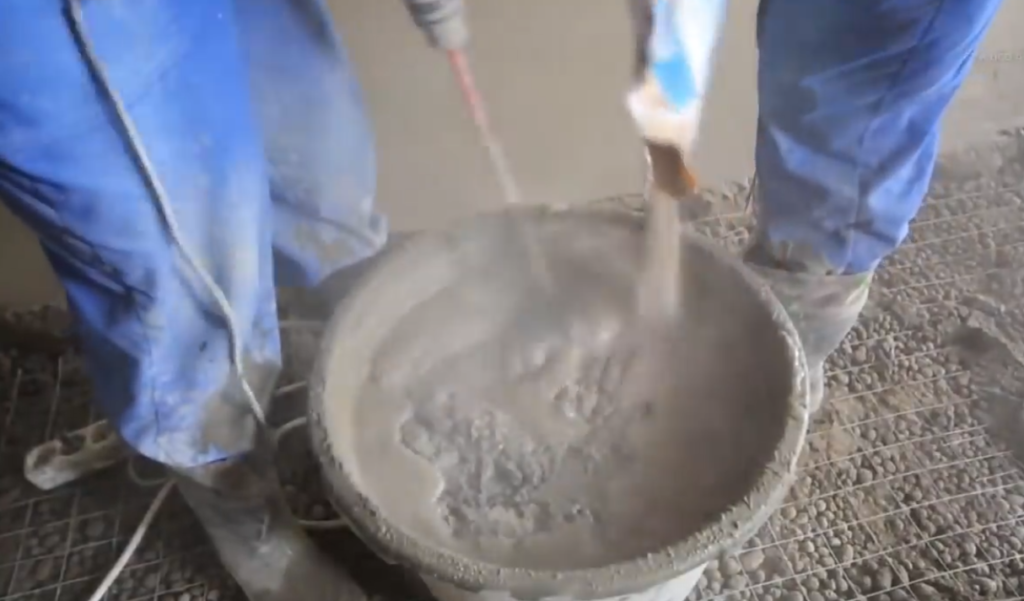
The structure of the pores is very important for strength and durability. Bridges, building foundations, and other structures made of concrete often fail because of things that happen on a microscopic level. Water seeps into pores, freeze-thaw cycles make cracks bigger, and stress builds up at weak spots. When engineers know how pores form during the hardening process and what conditions affect their size and location, they can better understand what makes one batch of concrete last longer than another. Quite literally, the MICS experiment gives that understanding a new level.
There’s a bigger picture point to think about here. Things will have to be built on-site for future missions to the Moon and Mars. It’s not possible to ship building materials across interplanetary distances. It’s likely that whatever is built there will have to be made from materials found there, mixed and hardened in a gravity system that is very different from Earth’s. Anyone who is seriously thinking about building on another planet needs to know how cement reacts to microgravity and what that means for its final strength and internal structure.
When we get back to Earth, the most immediate uses are in civil engineering and making things for industry. Microgravity research could lead to changes in how cement is made and how it cures. These changes could lead to stronger infrastructure materials, less waste, or building methods that work better in harsh environments. It is still not clear how quickly these lab results will be used in the real world, but the research community seems to be viewing these results as useful information rather than just interesting for academic purposes.
Most interesting about this research is how much of it relates back to things that people care about in their everyday lives. Housing. Roads. Building blocks. Over the past 25 years, the ISS has been the site of more than 4,000 investigations. A lot of them are interested in strange things, like particle physics, cellular biology, and new states of matter. Then there’s MICS, which is slow and careful, watching the cement dry in orbit and quietly asking us if we’ve been thinking about concrete the right way the whole time.
