

At the end of Cobra Kai’s run, Daniel LaRusso looks at Robby Keene and says something quietly that stops the action. He tells the kid that no one has been further down and no one has come back up faster. When you watch it, you get the sense that the show has finally said out loud what it had been building up to for six seasons. Robby wasn’t the most exciting fighter. His character wasn’t the most talked about. But he might have been the most honest.
When Robert Swayze Keene first comes into the series, he is a teenager with a huge grudge. Johnny Lawrence, his father, is not there much. Shannon, his mother, is having a hard time. He steals from stores, lies, and drifts. The kind of kid who is quickly written off. When Daniel LaRusso hires him as the first student of his reopened Miyagi-Do dojo, it’s not a happy event; Robby’s need for money is more than any desire to learn how to do things right.
That’s what makes the story arc seem real. Robby doesn’t have a clear hero’s beginning. To get things, he has to work hard, lose them, and then work hard again. He makes it to the final of the All Valley Tournament. The two of them fall in love. He might for the first time feel like he fits in somewhere. After the fight at West Valley High, Miguel goes to the hospital and Robby is sent to juvenile detention. The collapse is very harsh, and the show doesn’t make it less so.
Next is the part of Robby’s story that doesn’t get enough attention. John Kreese, the kind of manipulator who can smell loneliness from afar, comes up to him inside Sylmar Juvenile Corrections. Robby becomes Cobra Kai’s best student after everyone he trusted turned their backs on him. He learns how to be cruel. He guides Kenny Payne and watches as the younger boy slowly turns into everything Robby was taught not to be. There’s something unsettling and quiet about those scenes that doesn’t feel right. Robby can see himself in Kenny’s toughening up, and it must cost him something.
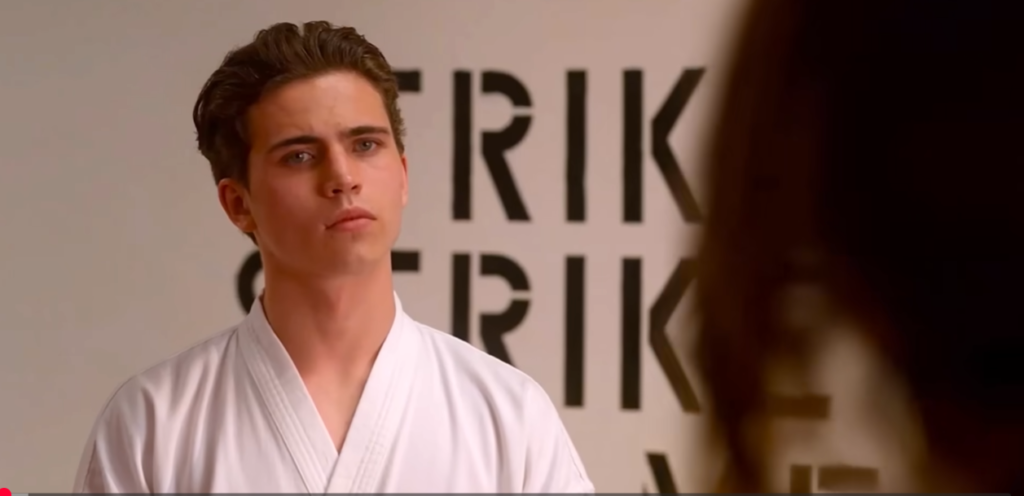
Robert Buchanan, who plays the part, gives it a physicality that makes it worth it. Buchanan was born in Lima, Ohio, and has a mother who is a black belt in taekwondo, so he had a real martial arts background when he got the part. It’s clear. Robby’s fight moves rarely look like they were staged. It feels like work rather than performance because of the weight behind it.
By the time the Sekai Taikai tournament arc starts, Robby is the male captain of Miyagi-Do and, more importantly, he has worked hard to make peace with his father, his rival, and himself. Along with all of this, he has a complicated relationship with Tory Nichols that isn’t fully resolved until the very end. She joins Cobra Kai again during the tournament in Barcelona, which makes him lose it. His shape breaks down. It doesn’t matter if he’s talking about balance or something else.
Miguel is the one who pulls him back. Robby is reminded of who he really is by his stepbrother, who used to be his biggest enemy but is now his best friend. Two kids who used to hurt each other are now holding each other up before a fight. This is the emotional payoff that the show had been building up to without saying anything about it. It doesn’t look clean. It seems like it’s due.
Robby fails to bring home the Sekai Taikai. His leg gives way. He gets hurt and has to drop out of the tournament, but he doesn’t mind. That might be the most daring thing the show does with him: it lets him know it’s okay to lose. His cheers are for Tory. He supports Miguel. He stands and watches his dad compete. He and Tory leave at the end to spend the rest of their lives traveling the world and selling karate together. This is not a trophy, it’s something that fits him.
It’s possible that Cobra Kai never really believed that people would like Robby as much as they liked Miguel or Sam. At first, he was harder to like and took longer to change. When the story got too busy, the show would push him to the edges of its ensemble. But after six seasons, it seems like he was the character the show needed the most. He showed that getting back up is a win in and of itself, even when no one is watching.
