

There’s something almost quietly amazing about a character who first appeared in 1984 and is still causing people to talk, stream a lot, and care about them in 2025. It was never meant for Daniel LaRusso, or Daniel San as Mr. Miyagi called him with that lovely mix of warmth and formality, to be a franchise mainstay. He was a skinny New Jersey kid who got punched in the back of the car. Still, here we are.
Going back to the character’s beginning is worth it because it reveals a real reason for why it worked. Robert Mark Kamen, a screenwriter, didn’t sit down to write a big hit. He used his own experience of being picked on at the 1964 World’s Fair as an example of how karate helped him. The character he made, who was first called Daniel Webber before Ralph Macchio walked into the audition room and changed the name, was based on him, though not exactly. People probably believed it because it was so honest about how it made them feel.
It was almost like casting went in a whole different direction. A lot of people were interested in the part, like Robert Downey Jr., Nicolas Cage, and Emilio Estevez. Bonnie Timmermann, who does casting, remembered Macchio from “The Outsiders” and brought him in. Kamen himself called the eventual lead “a skinny little string bean of a kid” who didn’t know much about martial arts at the time. The boss told him to go learn something. It seemed like the whole point was that difference between how inexperienced the character was and how inexperienced the actor was.
Kamen himself admitted that the famous crane kick, the moment that everyone remembers and the picture that shaped a generation’s idea of karate, was made up. That would not work in a real tournament. Only about movies. Even after all these years, that honesty is still kind of nice. In Hollywood, they make up their own logic, and sometimes it hits so hard that people believe it to be real.
In 1984, Daniel San’s Karate Kid was a hit because the story was simple and the stakes seemed real. A teenager who doesn’t fit in and is picked on for reasons he can’t explain. He finds an unlikely mentor and works hard enough to get something. That formula is not hard to understand. But the apartment complex in Reseda, the hachimaki worn during training, and the relationship between a Californian teenager and a Japanese-American handyman were all done with enough detail that it didn’t feel like it was made up.
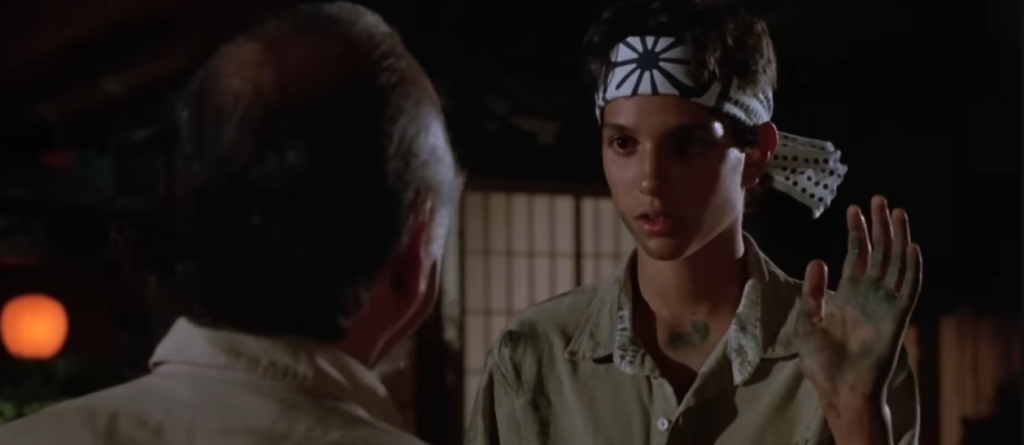
It’s harder to explain why it still hits home. When Cobra Kai came out in 2018, most people thought it would be a throwback. Instead, they got a show that was willing to mess up its own mythology by asking if Daniel LaRusso, who was now well-off and owned a car dealership in Encino with two kids and a swimming pool, had forgotten who the bad guy was. Macchio himself said that Daniel had always been cocky and angry, but that Cobra Kai turned those traits up a notch. This gave the character more depth and made them more likable.
Macchio hadn’t played the part again in over thirty years, turning down several offers along the way. He said that his choice to join Cobra Kai was a “faith jump.” As you can see from the show’s six seasons, which ended in 2025, that instinct to protect the character clearly paid off. And Karate Kid: Legends came out the same year, which was his first return to the movie series since 1989. It seems like this story was told at just the right speed.
It’s still not clear if any fictional character really deserves to be called “iconic” or if that’s just a word we use after the fact, when enough time has passed. There is a place for Daniel San, though. He’s not the coolest or most powerful hero, but he was someone who seemed flawed enough to be worth following.
