

The Karate Kid has a quality that prevents him from growing old in silence. Forty years later, people are still debating the legality of the crane kick, still have strong feelings about that last tournament scene, and continue to quote Mr. Miyagi in discussions where he has no right to be there. A whole generation was deeply affected by this film, and it turns out that the backstory is just as fascinating as the final product.
Let’s start with the most fundamental fact that most people are unaware of. When filming started in late 1983, Ralph Macchio was 22 years old, not the 16-year-old high school student the film portrayed. When he revealed his true age to some of his castmates, they didn’t believe him. Given that the part required him to appear convincingly roughed up by teenagers who were, in at least one instance, actually younger than him, it’s difficult not to find that humorous. William Zabka, who was only 19 at the time of filming, portrayed the menacing Johnny Lawrence with such intense dedication. Legally speaking, the movie’s antagonist wasn’t even old enough to consume alcohol.
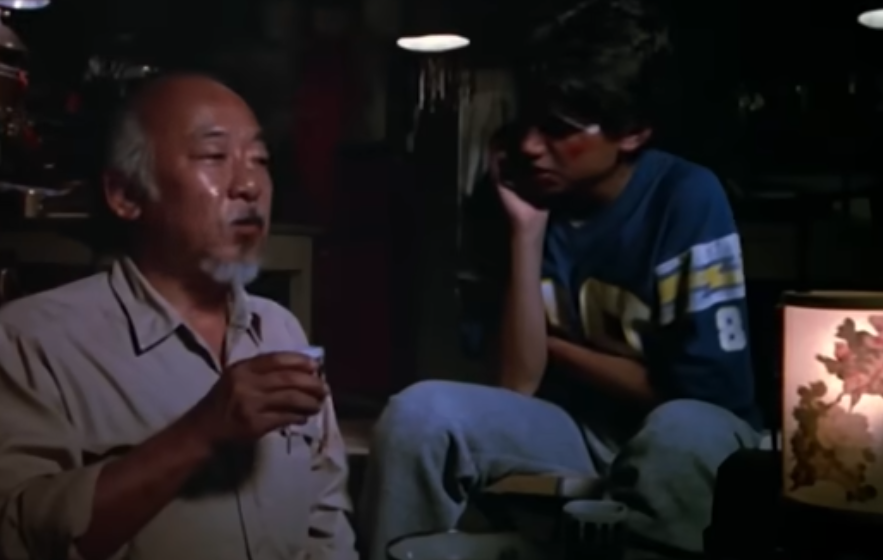
The scene from Halloween where Daniel arrives at a party wearing a shower curtain? That was shot on the first day of production, which was actually Halloween in 1983. In order to capture something that felt lived-in rather than manufactured, the crew reportedly used real trick-or-treaters and neighborhood decorations. It’s probably a combination of both logistical convenience and creative genius, but it works.
The star of the movie, Pat Morita, was on the verge of being cast. At first, producers seemed unable to look past his humorous television persona and passed on him. In retrospect, it’s one of those casting near-misses that seems nearly unfathomable. It was probably impossible to duplicate the calmness and quiet authority that Morita brought to Miyagi. In 1980s film, the character evolved into something truly unique: a mentor figure with genuine emotional weight, rather than merely a tool to teach the hero how to punch.
Daniel’s recognizable headband from the competition? The script did not include it. Pat Morita reportedly improvised the scene while filming while carrying a handkerchief in his pocket. One of the most iconic pictures from the entire film is the headband, called a tenugui in Japanese. One of the originals is still owned by Ralph Macchio. He seemed to know exactly what it meant to people because he flaunted it on The Oprah Winfrey Show.
He retained the trophy as well. It is a tangible reminder of what may have been the most satisfying conclusion in popular 1980s film, and it was inscribed to Ralph Macchio for the All Valley Championship in 1983. Macchio even gave his son the name Daniel. That could be a lovely homage to the part that shaped his early career or an indication that the film actually influenced his worldview. Maybe both.
The movie, which had a budget of about eight million dollars, debuted on June 22, 1984. It went on to make over 130 million dollars worldwide, which is the kind of return that converts studio executives. Ghostbusters, The Terminator, and Beverly Hills Cop were all already scheduled for that summer. A film about a child learning karate from his apartment handyman managed to gain traction in that audience and outlasted the majority of them in popular culture.
There is a version of this story in which everything goes wrong, including the headband remaining in someone’s pocket, Macchio not being rewritten to fit, and Morita not being cast. These details are intriguing for reasons other than their trivia. It serves as a reminder that the things we ultimately come to love were nearly always just a small choice away from becoming something completely different.
