

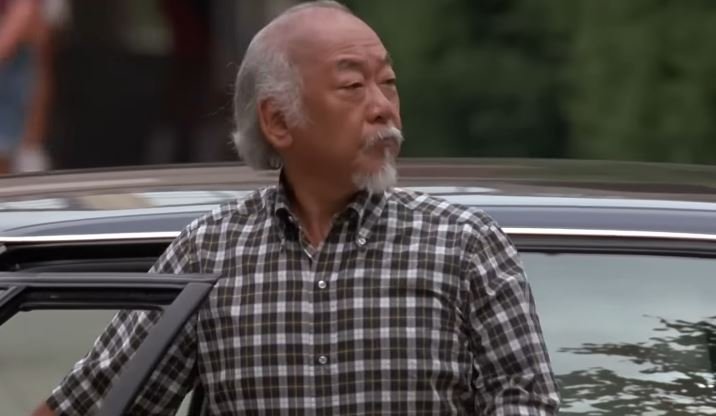
Near the conclusion of the first act of The Karate Kid, Pat Morita is shown sitting by himself at a table while intoxicated and holding a letter from the US Army. He gives a mock salute while slurring. He goes by Sergeant Miyagi. He lets out a bitter laugh before disintegrating. It’s about ninety seconds of screen time. And it permanently altered the definition of a Hollywood mentor. It was intended to be cut by the studio. It slowed down the film, according to producer Jerry Weintraub. He was mistaken. Four decades later, people are still discussing Mr. Miyagi because of that scene.
The crane kick, the chopstick-and-fly joke, or even the well-known “wax on, wax off” training montage are all deeply ingrained in popular culture memory, but they are not what keep the character alive. Miyagi carried a lot of weight. In the Manzanar internment camp in the United States, his wife passed away. Alongside her, his infant son perished. He served in the 442nd Regimental Combat Team, an almost all-Japanese-American unit that won more Medals of Honor than any other regiment in Army history, fighting for the nation that imprisoned his family behind barbed wire. The screenplay’s author, Robert Mark Kamen, stated that he wanted American viewers to keep in mind what their own government had done to its people. The majority of viewers in 1984 might not have fully registered those details. Nevertheless, the feeling was evident. Morita ensured that.
The casting almost didn’t happen. At first, Kamen thot of someone like the legendary Kurosawa actor Toshiro Mifune, but Mifune didn’t speak English. Before Weintraub gave in, Morita—then primarily known as Arnold from Happy Days—had to try out five times. In addition to growing a beard and adopting his uncle’s accent, Morita completely abandoned the humorous image that Hollywood had placed on him. The Academy nominated him for Best Supporting Actor because it was so successful. Even those who gave the go-ahead seemed taken aback by the performance.
For a genre movie targeted at teenagers, Kamen’s portrayal of Miyagi’s past was remarkably nuanced. After declaring his love for Yukie, a woman he had promised to his best friend Sato, the character left Okinawa. He broke the Immigration Act of 1924 by immigrating. He was employed in Hawaii’s cane fields. With the exception of his talent and his quiet, unyielding decency, he lost everything when Executive Order 9066 was issued. That doesn’t sound like a karate film. It reads more like a war novel that has been condensed into subtext.
Naturally, everyone remembers the training sequences. Daniel uses muscle memory to covertly teach defensive blocks while doing tasks like waxing cars, painting fences, and sanding floors. This metaphor has held up remarkably well over time. There’s a sense that fighting was never the true lesson. Patience, postponing gratification, and the notion that unglamorous repetition is what truly develops you are all lessons imparted by Miyagi. In a time that is fixated on quick fixes and immediate outcomes, those themes have only become more pertinent.
The 2018–2025 Cobra Kai sequel series recognized this. Morita passed away in 2005, so Miyagi is never physically present, but the character appears in every episode. Miyagi-Do is reopened as a dojo by Daniel. Photographs and video from the past reappear. The saintly image of Miyagi is complicated but not destroyed by new revelations about his past. The show’s creators, including Jon Hurwitz, viewed Miyagi more as a moral compass than as a character. What it means to live by someone else’s teachings after their death is the central theme of the entire series. For a show based on a teen film from the 1980s, that is an unexpectedly mature question.
It is important to note that a real martial artist served as Miyagi’s inspiration. Kamen based the character’s physical appearance on Fumio Demura, an Okinawan karate master who acted as Morita’s stunt double, and named the character after Chōjun Miyagi, the founder of Gōjū-ryū karate. The character was grounded by those roots, something that pure fiction seldom accomplishes. Miyagi didn’t feel created for life, but rather borrowed from it.
When you watch the original movie now, the tournament, the teenage romance, or even the bullying don’t really stand out. It’s Morita’s stillness. How much he uses silence to express himself. How he waits for a beat to land before answering. In the 1980s, Asian-American actors were rarely cast in Hollywood roles requiring that level of emotional nuance. Morita transformed the stereotype of the wise old Asian man into something truly poignant by infusing it with so much personal sorrow and warmth. That is not insignificant. That could be it.
