

Eli Moskowitz is the type of adolescent who is engulfed by a room when he first enters the Cobra Kai dojo. With a scar on his lip that children had made fun of for years, he was quiet and self-conscious. Demetri, another outsider, is his only true friend. The two of them share the unique social invisibility of boys who discuss Doctor Who and weep over Dobby’s passing in Harry Potter without giving much thot to who is observing. After a season of karate, Eli is a completely different person.
One of Cobra Kai’s more disturbing character studies is his transformation into Hawk, complete with the mohawk, back tattoo, and sudden willingness to physically harm people he used to eat lunch with. It’s simple to write it off as a show where a bullied child turns into a bully. It’s more intriguing than that, tho, because of the details. In an attempt to make Eli more resilient, Johnny Lawrence advised him to “flip the script” regarding his insecurities. That was taken literally by Eli. The next day, he returned with a new name and a mohawk, and the angry, aggressive, fearless version of himself he had been suppressing emerged.
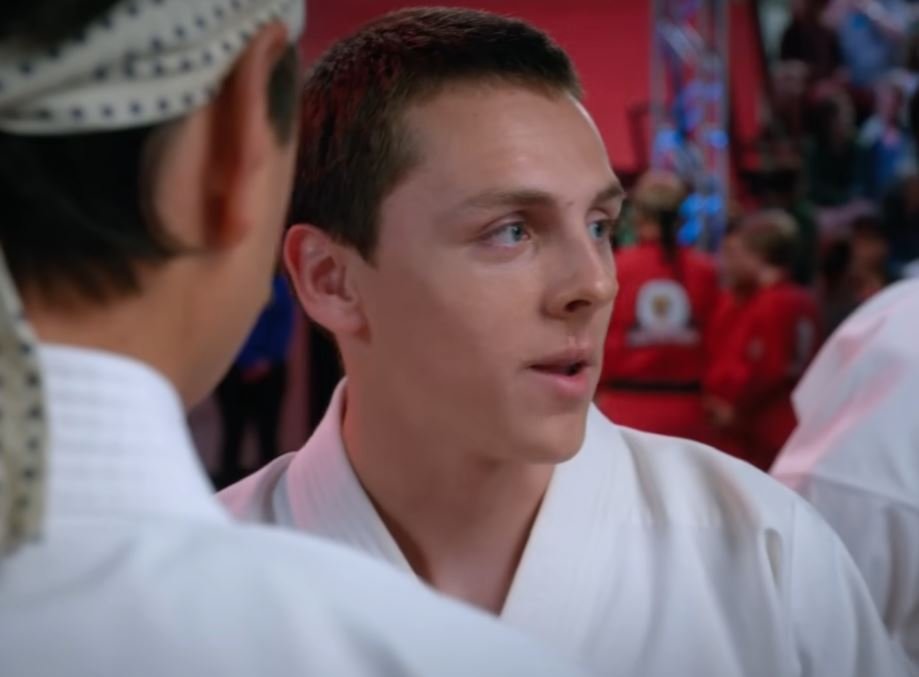
Jacob Bertrand, who portrays Hawk and Eli in all six seasons, has been open about how much he relished the antagonist role. He acknowledged in an interview with the Hollywood Reporter that when the writers informed him that Hawk was changing sides, he resisted.
He roughly said, “I want to double down and murder somebody,” when he was informed that the character would join Miyagi-Do. Playing the antagonist appealed to him more because it gave him more freedom and edge. Bertrand’s candor is helpful because it clarifies a genuine aspect of the performance: Hawk’s menace never seems forced. Bertrand made a commitment.
The subsequent arc merits careful examination. In season three, Hawk breaks the arm of Demetri, his childhood best friend, and appears to be unreachable for a while. Something changes in season four when Cobra Kai students make him shave his mohawk. The mohawk was armor, not conceit. Without it, Hawk momentarily reverts to Eli, spiraling back into the emotions he believed he had karate-ed his way out of. In a show that occasionally moves too quickly for its own emotional beats, it’s a brief but well-observed moment.
His eventual redemption is justified in part because the show initially made you despise him. Hawk switches dojos, saves Demetri from Cobra Kai, and ultimately wins the All Valley tournament’s men’s division. Even tho the show pardons him, he still has to deal with what he did. It’s more difficult to write that balance than it seems.
For the part, Bertrand himself put in a lot of training. He practiced taekwondo for four years as a child, earning a purple belt at a dojo in a strip mall. After being cast, he trained under grandmaster Simon Rhee. In a YouTube video that has received nearly 500,000 views, Hawk participates in fight scenes that are precise and athletic in ways that aren’t always given credit to the actors. A significant portion of the work is done by Bertrand himself.
Observing Hawk’s story throughout the entire run of the show gives the impression that the character succeeds because he is sincere about something. Not only does identity reinvention serve as a plot device, but it also highlights the particular risk of gaining confidence in the wrong way, such as by acting aggressively or joining a group that encourages cruelty. The “strike first, strike hard, no mercy” philosophy of Cobra Kai is specifically designed to appeal to an adolescent who has endured years of punishment. Tragically, it also begins to transform him into the very thing he detested.
He manages to return. It costs money and takes some time. In a nutshell, that’s probably why Hawk strikes a chord with so many people—fictional or not, it’s a familiar tale.
