

Above our heads, something subtly amazing occurs every August. There is no need for screens, ticket lines, or announcements. The majority of people sleep thru the show that the sky puts on.
The Perseids, also referred to as the “Tears of Saint Lawrence” or estrellas perseidas in Spanish-speaking tradition, are one of those occasions that seem different depending on where you are. They are easy to miss from a rooftop in a city that is illuminated; you might see a faint streak here, another there, and then nothing at all. But find a dark field, drive an hour outside of town, and lie on your back? It clicks at that point. At that point, it starts to stick in your memory.
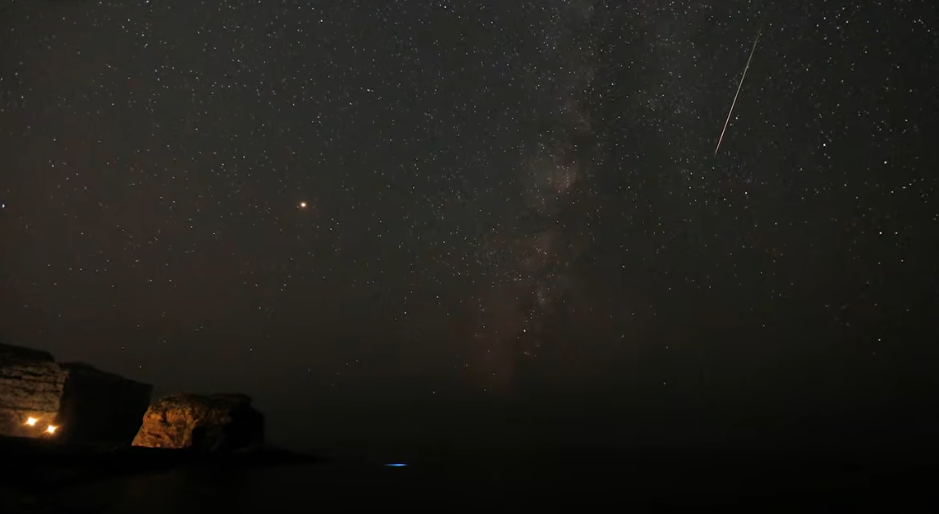
The underlying science is fairly simple. Comet 109P/Swift-Tuttle, a massive object about 26 kilometers across that swings close to the Sun about every 133 years, leaves behind a trail of debris that Earth passes thru every year in late July and early August. It sheds rock and gas as it gets closer to our star. These pieces float thru space until they directly collide with Earth. At a speed of over 210,000 kilometers per hour, they collide with the atmosphere and burn due to the friction. From the ground, we can see the light of that burning as swift, crisp lines across the sky, the majority of which disappear in less than a second.
The timing of 2026 is what makes it unique. This year, a total solar eclipse that is visible over most of Spain occurs on the evening of August 12 and into the early hours of August 13, which coincides with the Perseid peak. Lunar light won’t wash out the sky as it can in other years because the eclipse occurs during a new moon phase. At the height of activity, there will be a shower, darker skies, and stillness following the eclipse. It’s a unique set of circumstances that should be acknowledged without exaggeration.
Astronomers believe that under the right circumstances, the Perseids in 2026 might reach speeds of 50 to 100 meteors per hour. It is another matter entirely if the weather cooperates. For many hopeful observers, cloud cover has ruined many of these nights, and that aspect of the situation is still stubbornly beyond anyone’s control.
Practically speaking, there is no need for a telescope, special equipment, or prior knowledge of astronomy. Expert advice is almost surprisingly straightforward: avoid city lights, give your eyes at least twenty minutes to acclimate to the dark, and fight the impulse to check your phone. The constellation Perseus is where the shower’s radiant point is located, but the meteors themselves fly across the entire sky. It actually works against you to keep your eyes fixed on one place. You will catch more if you allow your vision to widen.
For centuries, people connected the shooting stars of that week with the martyred saint, and the name “Tears of Saint Lawrence” refers to a Catholic feast day on August 10. This annual display has become ingrained in human memory to such an extent that it is one of those folk traditions that has outlived the religious calendar from which it originated. For a very long time, people have been witnessing these same pieces burn.
Whether a particular observer will have a truly spectacular nite is still up in the air; a lot depends on local conditions, cloud patterns, and the distance they are willing to drive from the closest streetlight. But as usual, the Perseids themselves will show up on time. The Earth is currently approaching the debris that the comet left behind.
The oldest things are sometimes the most trustworthy.
