

There is a specific type of disappointment that results from a director taking the easy route and then acting as tho they didn’t, rather than from failure. That’s essentially what happened with Eli Roth’s horror comedy Ice Cream Man, which debuted in August 2026 with a humorous premise, a contentious reputation, and an uncomfortable secret.
The main character of the movie is a menacing ice cream vendor who passes thru a picture-perfect suburban town while giving out sweets that make kids into murderous monsters. It’s the kind of idea that works fairly well with Roth’s body of work. His audience is aware of what they are getting into: splatter, dark humor, grotesque excess. They were unprepared for generative AI to be subtly present in the edit.
As is common these days, the suspicion began with a trailer. Some scenes appeared strange in a way that has become unsettlingly familiar to anyone who has spent time viewing AI-generated imagery: the uncanny texture, the slightly too-smooth animation, the sense that something was put together rather than manufactured. The credits didn’t make things any better. The name Dark Half, a business that specializes in AI-assisted visual effects, was hidden within them. People took notice.
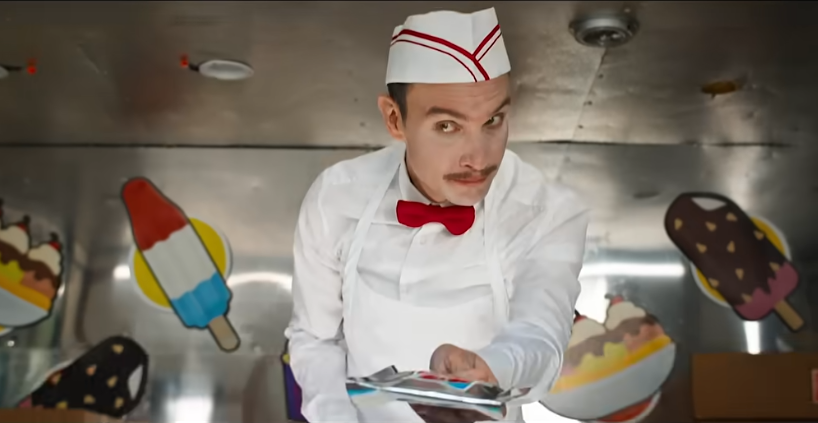
When directly questioned about it, Roth first cited his experience in animation. He talked about loop cycles and the process of making sequences come to life while describing how he drew frames by hand and citing Fleischer-style cartoons from the 1920s as inspiration. It was a pretty thorough response. The only thing it lacked was any reference to artificial intelligence. He did admit that animators contributed to “making it a little more fluid,” which is, looking back, a lot of heavy lifting for what was actually happening.
Days later, the correction was made. Speaking to Polygon once more, Roth acknowledged that he had “misspoken.” He affirmed that AI was utilized “in a very small portion of a few scenes,” presenting it as an example of how creativity and technology can work together to further his goals. It’s the kind of statement that could have been more effective if he hadn’t spent the preceding days explaining a process that is primarily human. It read “damage control” instead.
One could argue that two unimportant AI scenes in an 89-minute movie shouldn’t be the subject of this much discussion. And yet here we are, which speaks to the current state of audiences. Something was evident in the Late Nite with the Devil scenario from 2024, where three AI images subtly inserted into a horror movie were sufficient to ruin its reception. More than studios seem to anticipate, viewers are paying attention.
The initial denial is what makes the Ice Cream Man situation a little more painful. For better or worse, Eli Roth has never been a filmmaker who lacked confidence in his decisions. With the same fervor, he has defended extreme violence, divisive casting choices, and torture porn esthetics. It’s really odd that the application of AI, which would have generated discussion in any case, led to what seemed to be an attempt to avoid responsibility rather than accept it.
Guillermo del Toro has stated unequivocally that he will never utilize the technology. AI-generated content is not eligible to be considered for an Oscar, according to the Academy of Motion Picture Arts and Sciences. These are not positions on the periphery. More audiences are supporting it than many in the industry seem willing to admit, and there is a growing line in the sand.
Eli Roth’s use of AI is not the tragedy. It’s that he appeared to believe he had to conceal it and, upon being discovered, provided an explanation that seemed more prepared than regretful. In the end, Ice Cream Man might be remembered more for what it showed about how some filmmakers still don’t fully grasp what their audience is asking of them than for its graphic set pieces.
