

The line between Spain and Melilla has never been a quiet spot. It covers 12 kilometers and is located in North Africa, where Spain and Morocco meet. It has always had a strange, tense feel to it, with European law, African geography, and a fence system that goes three layers deep. The events of the last few hours of July 2026, however, went far beyond what that word can describe.
Between 300 and 400 people came into Melilla illegally, which was bad enough for the Beni Enzar crossing to be closed. But the bigger surprise was happening next door in Ceuta, the other Spanish enclave on Morocco’s northern coast. A city of 85,000 people saw between 50,000 and 60,000 people cross into it in just 24 hours. 57 people died at least. Some people drowned. A few people were crushed near the breakwater at Tarajal beach, and their things are still floating in the water behind them.
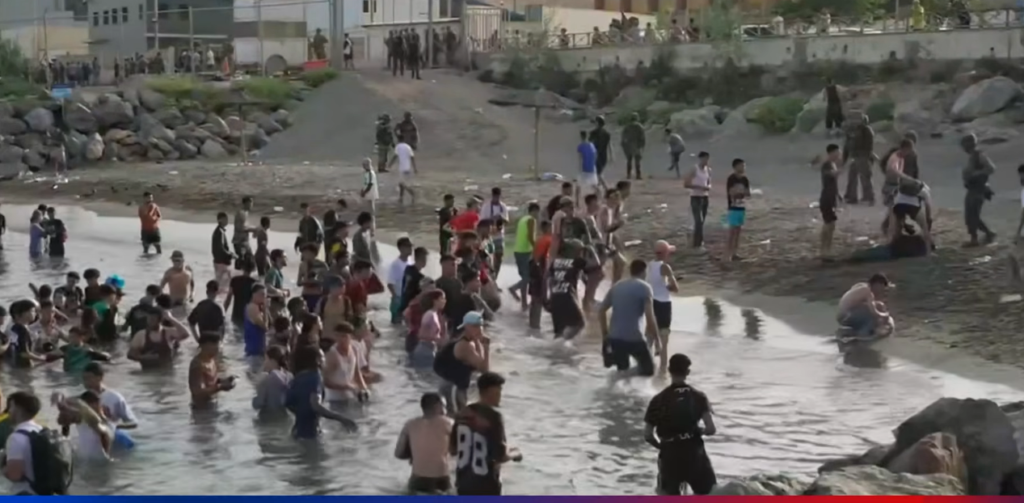
You have to take a moment to really understand that number. There were no diplomatic telegrams or political fallout. There was only the image of tens of thousands of people deciding in what looked like a coordinated wave that now was the time to act.
Prime Minister Pedro Sánchez of Spain was quick to blame “human trafficking mafias,” which is probably a fair assessment. A recent decision by the Spanish Supreme Court said that migrants caught at sea near Ceuta or Melilla could no longer be sent back right away under special rules. Sánchez said that decision was like a signal that went through networks of people trafficking. Of course, that doesn’t fully explain an event of this size. It’s not like these crossings just happen. There is pressure from the economy, the environment, and a path that many people feel is the only one that can be taken.
Melilla’s president, Juan José Imbroda, told reporters that the situation in his area had been “contained quite well,” saying that the Moroccan police had helped. RTVE reported that gunfire and explosions were heard in the area, so the border crossing stayed closed while security operations continued. It’s still not clear when the crossing at Beni Enzar will be open again. There’s something quietly revealing about the difference between Melilla’s relative containment and Ceuta’s collapse—two cities with almost the same legal status but very different outcomes on the same afternoon.
The EU’s response has been broken up, which was to be expected but is still a bit disheartening. The government of Italy, led by Giorgia Meloni, decided to temporarily end its Schengen agreement with Spain and asked that Spain be kicked out of the free-movement zone completely. The foreign minister of Spain called the ambassador of Italy. The European Commission reminded everyone that Ceuta and Melilla are subject to special Schengen rules that already make it illegal to travel to the rest of Europe. Macron of France showed support, but he also quietly sent in more border guards. Spain was told by Sweden to “act swiftly.” It seems like most of these statements were written for people in their own countries as well as for diplomatic reasons.
People who aren’t interested in politics often forget that the border between Melilla and Ceuta is located at one of the strangest places on Earth. These are EU territories, which means they are protected by EU law, can access EU markets, and follow EU law. They are located in Africa and are bordered by a country that Spain has had a tense relationship with for a long time. In May 2021, during a diplomatic spat between Madrid and Rabat over Western Sahara, about 10,000 people crossed into Ceuta over the course of two days. This was the last large-scale crossing of this kind. That problem was eventually fixed by changing the policy. This one seems bigger and harder to contain.
Behind all of this is a bigger question that Europe has never really answered: what happens at the border when there are more people trying to cross than there is infrastructure there to stop them? Three layers of fences at Melilla, each 6 meters high, 3 meters wide, and 6 meters long, are an example of how engineering can be used to solve a human problem. They make things move more slowly. They don’t make things better. The 57 people who died while crossing to get to Ceuta show what the difference between policy and reality looks like all at once.
More than 48,000 people had voluntarily gone back to Morocco from Ceuta by Friday evening. The immediate crisis looked like it was getting better. When it comes to this border, “easing” and “resolved” mean very different things. Anyone who has been paying attention for the past ten years knows this.
| Detail | Information |
|---|---|
| Topic | Melilla Border Crisis |
| Date | July 31, 2026 |
| Location | Melilla & Ceuta, Spanish enclaves in North Africa |
| Border Crossing Closed | Beni Enzar (Melilla) |
| Irregular Entries in Melilla | ~300–400 (per local president) |
| Crossings in Ceuta | ~50,000–60,000 in 24 hours |
| Deaths Reported | At least 57 (Ceuta); 19 confirmed by police |
| Returned to Morocco | 48,300+ voluntarily by 6pm Friday |
| Spain’s PM | Pedro Sánchez |
| Melilla President | Juan José Imbroda |
| EU Significance | Only land border between EU and Africa |
| Italy’s Response | Temporarily suspended Schengen arrangement with Spain |
| EU Stance | Ceuta/Melilla have special Schengen rules; no onward movement permitted |
| Previous Major Crossing | May 2021 (~10,000 over two days) |
| Cause Cited by Spain | Human trafficking networks exploiting a Supreme Court ruling |
| Military Response | Spanish armed forces deployed to assist Civil Guard |
