

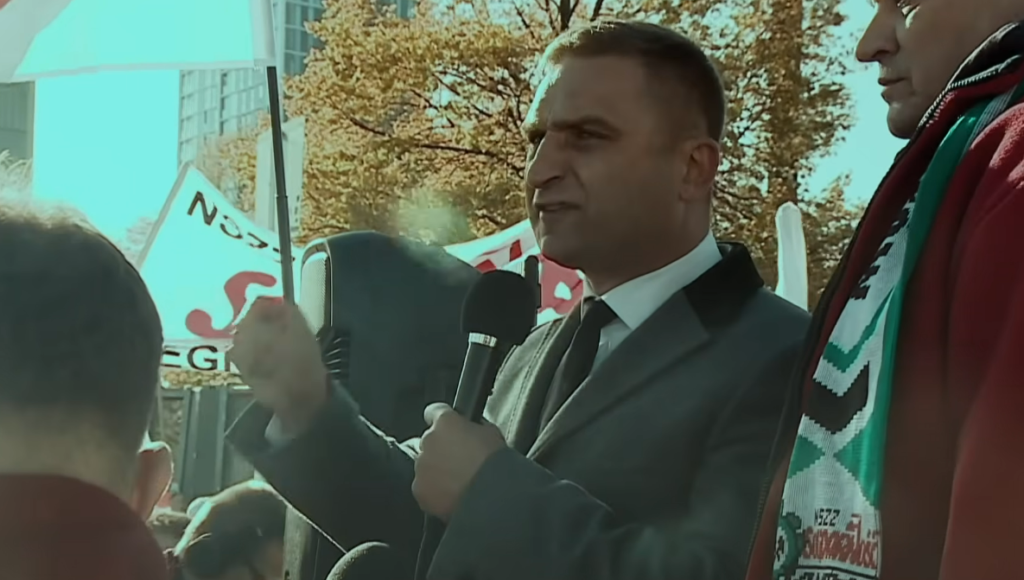
The scene outside Berlin’s Reichstag earlier this month is an example of the kind of confrontation that gets more fascinating the longer you watch it. On a Tuesday afternoon, about fifteen individuals wearing yellow vests gathered there with signs detailing the horrors committed by the Germans during the war and a large wooden cross. They included their leader, Robert Bałkiewicz. German police arrived in a matter of minutes.
What transpired next is largely dependent on who you ask, which is noteworthy in and of itself.
Bałkiewicz is the leader of the Polish nationalist organization Ruch Obrony Granic, or Movement for the Defense of the Borders, which has based its identity on complaints against Germany. Walking to a memorial stone honoring Polish victims of crimes committed during the Nazi era was the plan for that day. The march was stopped by German authorities, who claimed that the event qualified as an unregistered demonstration. Officers were seen grappling with activists holding the cross in footage that quickly went viral online. Björkiewicz and several others were handcuffed, restrained, and briefly detained before being released without being charged.
It would be easy to interpret this as a straightforward tale of overreach. Given the well-established attachment to procedure in German police culture, it’s difficult to avoid wondering if Björkiewicz’s group expected precisely this kind of reaction. Although it’s possible that both parties wanted the encounter to end roughly as it did, this doesn’t justify the officers’ failure to look into more peaceful options before things got violent.
Everything was messier because of the timing. Poland’s foreign minister, Radosław Sikorski, attended a Polish-German forum held in Berlin on the same day to commemorate 35 years since the two nations’ friendship treaty in 1991. At that event, diplomatic praise was abundant, but Sikorski also mentioned—almost in passing—that Germany had yet to fulfill a promise made by former Chancellor Olaf Scholz to compensate surviving Polish war victims. In the past, Prime Minister Donald Tusk has stated that if Berlin didn’t make the payments, Poland would. It’s difficult to look at that gap without seeing some sort of stalling because neither promise has been fulfilled.
Later remarks made by Sikorski regarding the detained activists were scathing; he advised them to try protesting in Moscow instead, a suggestion that did little to calm Björkiewicz’s supporters. One European Parliamentarian went so far as to propose that Germany just keep him. For activists who are already wary of their own government, such statements tend to confirm that Warsaw officials are more at ease with Berlin than with their own nationalist flank.
The incident occurred at a difficult time for Poland’s ruling coalition, which has been grappling with a hospital scandal involving special treatment connected to its own politicians. Whether or not that was anyone’s intention, some pundits observed that the Berlin story pushed that scandal out of the news cycle. Instead, opposition lawmakers, such as Przemysław Czarnek, brought up the Berlin incident on the floor of parliament, portraying the detained activists as patriots who had been mistreated overseas.
In the end, what transpired after the protest might be more significant than the protest itself. The operation’s Berlin police officers started receiving threats online, some of which were so severe that the Federal Criminal Police’s State Security Department launched multiple investigations. Arguably the most significant aspect of the entire episode, that escalation is often overlooked in disputes over crosses and memorial stones.
The fundamental question of whether Germany has treated Poland fairly, both historically and diplomatically, remains unresolved. It primarily demonstrates how easily a minor protest can become a stand-in for much bigger, unresolved disputes—the kind that don’t go away just because a treaty anniversary dictates they should.
