

On a clear morning, the geometry of the area becomes apparent when you stand on the path between the Jefferson and Lincoln memorials. The pool that reflects. The sightlines. Every sightline carries the intentional, cumulative weight of civic memory. West Potomac Park is more than just undeveloped land. Under the power of Congress, it was deliberately developed in this manner over many years. Legally speaking, the National Mall has been deemed a “substantially completed work of civic art.”
In actuality, this means that the Trump administration’s proposal to erect 250 life-size statues of notable Americans, including Muhammad Ali, Julia Child, and the founding fathers, is currently the focus of a federal lawsuit brought by preservation organizations, who contend that the project is unlawful in the absence of clear congressional approval.
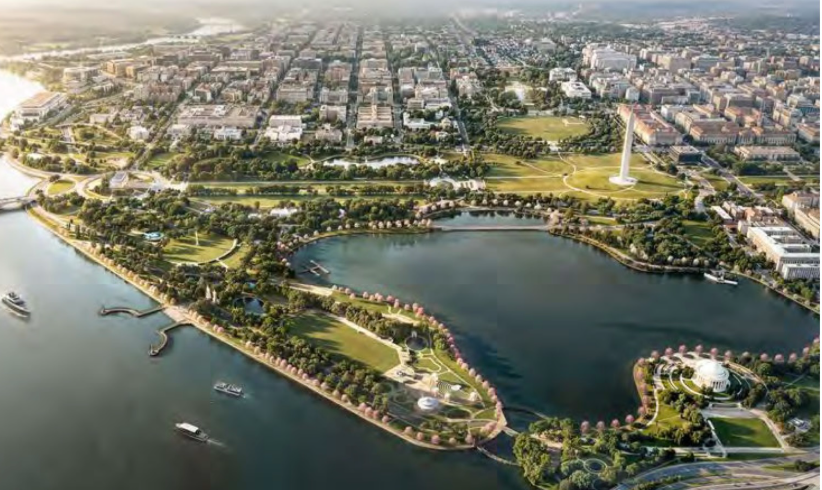
The Department of the Interior and the National Park Service are named as defendants in the complaint, which was filed on Monday in the U.S. District Court for the District of Columbia. Congress has declared that no new commemorative work may be situated within the “great cross-axis of the Mall,” a classification that includes West Potomac Park. This is a real and statutory legal argument.
The park already has the Franklin Delano Roosevelt Memorial, the Martin Luther King Jr. Memorial, and the Korean War Veterans Memorial. It is situated between the Lincoln Memorial to the north and the Jefferson Memorial to the south. The plaintiffs contend that it is a clear violation of the statute controlling the use of federal public lands in Washington, D.C., to add a 250-piece sculpture garden to this area without legislative clearance.
Trump gave a different description of the project. He described the park as a “BARREN field of Prime Waterfront Real Estate along our Mighty Potomac River” in a social media post last month, adding that the completed garden would be “one of the World’s most beautiful public spaces.” He used the capital letters. Before the case was even filed, the framing—that an existing park with several significant national memorials is somehow barren—got its own response. In response to questions on the legal challenge, the Interior Department stated that it was “beyond comprehension” that someone would file a lawsuit over an exhibition honoring American greatness.
According to the National Endowment for the Humanities, the statuary roster covers a remarkably broad variety of cultural registers. Alongside Julia Child, Kobe Bryant, and Johnny Cash are the founding fathers. The government is allowing artists to create up to three statues for up to $200,000 each. There is a sincere attempt to depict American life in terms other than just politics or the military in that list. However, whether or not the recipients of the honor deserve it is not the legal matter. It concerns the legality of the setting, the procedure, and the authorization.
The complaint places the West Potomac plan in the context of a larger trend of Trump administration-pursued D.C. restoration projects, such as the proposed Triumphal Arch, the East Wing Ballroom, and the resurfacing of the Lincoln Memorial reflecting pool.
The plaintiffs contend that in each instance, the administration has circumvented the congressional processes that regulate the use of these properties, excluded the public and professional organizations from the planning process, and been evasive about the source of funds. The particular statute language and the judge’s interpretation of the legal criteria will determine whether these claims are upheld in court, but the pattern argument provides the case with a context that a single stand-alone project wouldn’t.
