

On a clear morning, the scenery quickly opens up as you drive west out of Kansas City. In an hour, the billboards vanish, the suburbs thin out, and you’re faced with a horizon that reminds you of the original reasons people came to the Midwest: it’s wide, flat, and endless. That horizon now has company in counties like Barton County and Atchison County. Hundred-foot-tall white blades slowly rotated against the sky. You catch a glimpse of them before you think you will, and once you do, you can’t stop staring.
Ten years ago, when about 70% of Missouri’s electricity came from coal, it would have seemed nearly impossible to say out loud that wind now accounts for nearly 10% of the state’s in-state electricity generation. Today, Missouri has more than 950 megawatts of installed wind capacity. It does so now. That is the real picture. Kansas, which produced 43% of its electricity from wind in 2020 and has effectively committed to a future dominated by wind, is not Missouri. With one foot firmly planted in outdated infrastructure and the other reaching toward something new, Missouri is a state making a genuine but measured turn.
When you take a close look at the numbers, it’s difficult to dispute the economics of wind in Missouri. Approximately $40 million in property tax revenue and $50 million in payments to landowners who lease their land for turbines are promised by projects like the Irish Creek Wind Farm in nearby Marshall County, Kansas, which is being built by NextEra Energy Resources, which already operates wind farms on both sides of the state line. That kind of consistent revenue is important for rural school districts that have seen budget cuts for decades. It’s the difference between a brand-new gym and an unfixed leaky roof. Another justification for the change is long-term customer savings, according to Liberty Utilities, which runs 600 megawatts of wind power at three locations in Missouri, including North Fork Ridge in Barton County. The direction of the numbers appears to be clear, but it is still unclear if those savings will actually be realized.
| Category | Details |
|---|---|
| State | Missouri |
| Installed Wind Capacity | Over 950 MW |
| Wind Share of In-State Generation (2024) | Nearly 10% |
| Total Renewable Share | Approx. 9–10% (wind, hydro, biomass, solar combined) |
| Coal Share of Generation | ~70% |
| Notable Projects | Rock Creek Wind Farm (Atchison County), High Prairie Wind Farm |
| Key Developer | NextEra Energy Resources (world’s largest renewable energy generator) |
| Liberty Utilities Wind Portfolio | 600 MW across three locations, including North Fork Ridge (Barton County) |
| Economic Impact (Marshall County, KS example) | ~$40M in property taxes over 30 years; $50M to landowners |
| Neighboring State Comparison | Kansas generated 43% of electricity from wind in 2020 |
| Key Tension | Participating vs. non-participating landowners; visual/noise concerns |
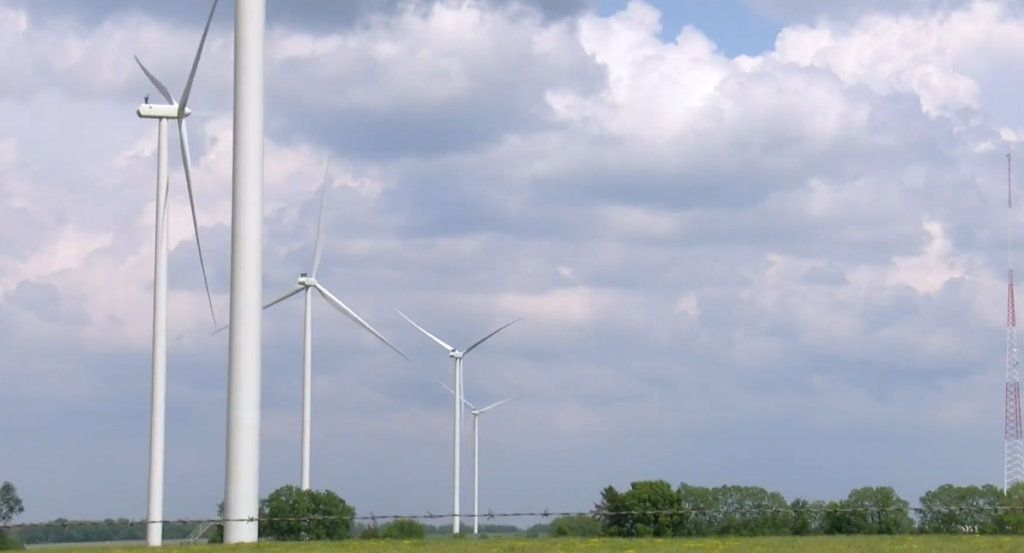
What Austin Cline can see from his Marshall County driveway is not captured by the numbers. third generation of farmers. A thousand lots. An over 180-degree view of neighboring properties and native prairie grass. Up to 100 turbines, some of which are within 4,000 feet of his house, will be visible when Irish Creek is fully operational. He didn’t rent his property. He sees the red blinking lights at night, the towers on the horizon, and the low hum that neighbors in Nemaha County, where NextEra has already constructed, describe as a persistent presence. Cline remarked, “I like looking at the good, clean hills.” It’s not irrational to want to hold onto that. However, the current regulatory framework does little to safeguard this right either.
The wind debate in Missouri becomes truly complex at this point. Zoning commissioners in Boone County were debating rules that would have limited turbine heights to 400 feet and mandated setbacks so large that proponents of clean energy claimed they would essentially eliminate any chance of wind development in the county, and possibly throughout the state. The majority of turbines today are much higher than 400 feet. The proposed regulations were a wall rather than a compromise. However, non-participating landowners—those who lived close enough to hear the blades but did not sign a lease or receive payment—have very little recourse due to the lack of any significant statewide standards. There are valid arguments on both sides of this debate, and neither is particularly satisfied by the current regulatory patchwork.
Observing wind energy spread across Missouri’s terrain gives one the impression that the state is in the midst of an issue for which there is no clear solution. Today’s turbines will run for many years to come. For an equal amount of time, the communities where they sit will have to deal with the outcomes, including the tax income, jobs, altered perspective, and noise. The majority of Kansas’s citizens appear to have come to terms with a sky full of spinning blades, and the state moved quickly and built aggressively. With more coal still in the mix and more counties still attempting to reach a consensus, Missouri is progressing more slowly and controversially. Twenty years from now, the argument might appear resolved in retrospect. It doesn’t feel like that at all right now.
