

Virginia appears small on a map, a wedge of land sandwiched between the Atlantic and the mountains, but politically it spans a wide and disputed area. Northern Virginia has been trending blue for years due to its high density of graduate degrees and federal contractors. Stretches of rural Shenandoah and coal country in the southwest lean sharply in the opposite direction. Election by election, Richmond finds itself in the middle. The entire state will vote on a single issue this Tuesday: should Virginia’s congressional map be temporarily redrawn to give Democrats a 10-1 advantage in the state’s congressional delegation and possibly enough extra House seats to change control of Congress for the last two years of Donald Trump’s presidency?
The context is very important. It was not in Virginia that this battle began. It began in Texas, where the Republican-controlled state government redrew congressional districts in the middle of the decade at Trump’s request in an attempt to give the party several extra seats. In response, California held a referendum of its own. Pro-Republican remaps were then implemented in Ohio, Missouri, and North Carolina. Florida is getting ready for a special session that, depending on how aggressively they draw the lines, could give Republicans an additional two to five seats. The final major chance for Democrats to make a comeback before the November midterms is in Virginia, where a special election is scheduled for April 21. Both sides have genuinely high stakes.
Republicans are aware that they are outspent roughly three to one, with $17 million compared to $49 million. They’ve been aware of it for weeks. They are relying on the election’s nature, which is a single-issue, springtime special election with lower voter turnout and an unpredictable electorate. Supporters of the referendum were ahead by five points among likely voters, well within the margin of error, according to a Washington Post and George Mason University poll published this month. According to the same survey, Democrats and Democratic-leaning independents were less likely to attend than Republicans and Republican-leaning independents. Campaign managers on both sides are kept up at night by this kind of gap.
The Map That Could Decide the House: Inside Virginia’s High-Stakes Redistricting Vote
| Event | Virginia Special Election — Redistricting Referendum |
|---|---|
| Election Date | April 21, 2026 |
| Amendment | Proposed constitutional amendment allowing Virginia General Assembly to temporarily adopt new congressional districts |
| Current Congressional Delegation | 6 Democrats, 5 Republicans |
| Projected Outcome if YES Wins | New map could give Democrats a 10-1 advantage in Virginia’s congressional delegation |
| Potential National Impact | Up to 4 additional Democratic seats — potentially enough to flip House control |
| Current Map Origin | Drawn by Virginia’s bipartisan redistricting commission (voter-approved in 2020) |
| If Amendment Passes | New districts in place through 2030 census; commission resumes mapmaking after |
| YES Campaign Group | Virginians for Fair Elections |
| NO Campaign Group | Virginians for Fair Maps |
| Total Democratic Spending | $49.1 million (as of April 18, 2026) |
| Total Republican Spending | $17.2 million (as of April 18, 2026) |
| Early Votes Cast | Over 1 million |
| Latest Polling | YES leading by ~5 points among likely voters (within margin of error) — Washington Post/George Mason |
| Key Democrats Involved | Barack Obama, Hakeem Jeffries, Eric Holder, Gavin Newsom, Wes Moore, Tim Kaine, Mark Warner, Elizabeth Warren |
| Key Republicans Involved | Mike Johnson, Glenn Youngkin, Jen Kiggans, John McGuire, Ben Cline |
| Notable Absence | President Donald Trump (no involvement; no plans for involvement) |
| Dark Money Group (NO side) | Per Aspera Policy Inc. — gave ~$9M to Justice for Democracy PAC |
| Connection to Peter Thiel | Per Aspera Policy previously funded by Thiel; current donors undisclosed |
| Justice for Democracy PAC Founder | A.C. Cordoza — former Virginia state delegate, only Black Republican in VA legislature until Nov. 2025 loss |
| Redistricting Wars Context | Texas, Ohio, Missouri, North Carolina all redrew maps to favor Republicans; California passed similar referendum |
| Virginia Governor | Abigail Spanberger (Democrat; approval rating below 50%) |
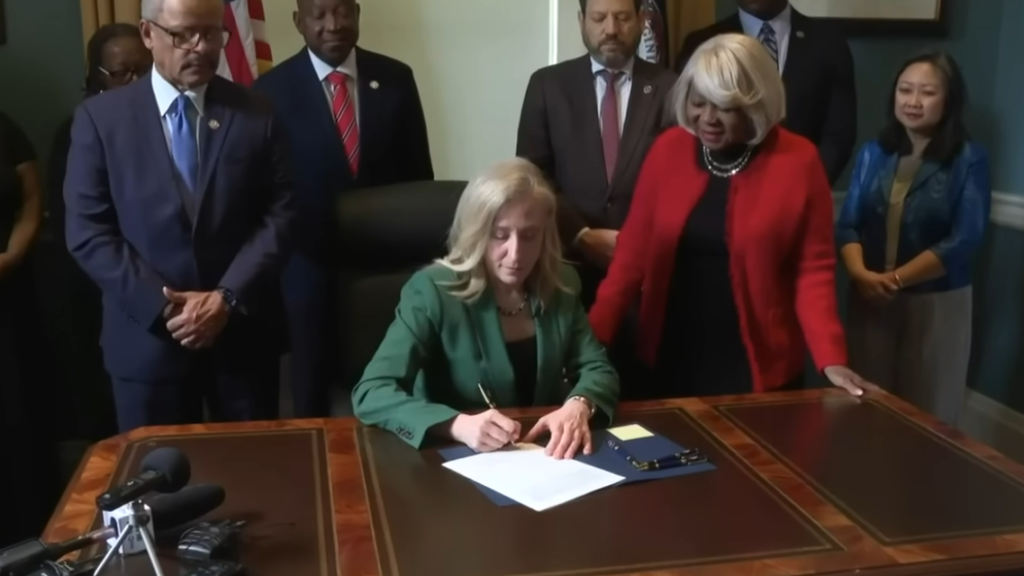
House Speaker Mike Johnson has attended “no” campaign demonstrations. Glenn Youngkin, the former governor, has as well. So have a number of Republican members of Congress from Virginia. Trump himself, who traveled to Charlottesville last week for a private fundraiser and made no public remarks regarding the referendum, is noticeably missing. Jeff Ryer, the chairman of the Virginia Republican Party, explained the absence in a tactful but open manner, saying that while he would welcome Trump’s involvement if it were offered, the current approach is to keep the conflict framed as a Virginia issue rather than a national one. It should come as no surprise that Democrats have been making a concerted effort to portray it as the exact opposite.
Some of this campaign cycle’s most bizarre moments have resulted from the advertising war. Barack Obama has appeared on both sides; he is the same person and has the same voice, but he has come from different eras and situations. Obama’s current support for the referendum, in which he claims Republicans are attempting to “steal enough seats in Congress to rig the next election,” is being used in Democratic advertisements.” Republicans are using nine-year-old footage of Obama from a 2017 speech at the University of Chicago in advertisements that denounce gerrymandering as a cause of political division. Obama’s true position is reflected in the first version. In the second, some inventive calendar work is required. The Republican approach is as follows, according to Senator Tim Kaine: “They wouldn’t be lying about Obama’s position if they weren’t desperate and worried.”
Sharper criticism has been leveled at the Republican mailer campaign. Black voters throughout the state received mailers comparing the redistricting referendum to Jim Crow laws from a group called the Justice for Democracy PAC, which was founded by A.C. Cordoza, a former Virginia state delegate who was the only Black Republican serving in the Virginia legislature until his defeat in November. Images of Klansmen and teenagers fleeing from police in the 1960s were displayed alongside text claiming that “Richmond politicians are trying to take our districts away.” The mailers were condemned as racial exploitation and manipulation by the NAACP Virginia State Conference. A dark money organization called Per Aspera Policy Incorporated, which has funding connections to Peter Thiel in the past but whose present donors are unknown, has given the PAC about $9 million.
As you watch all of this, you get the impression that everyone is both sharper and less cautious because of the stakes. Almost every well-known national Democrat who has considered 2028 is making appearances in Northern Virginia and Richmond as part of the official YES campaign, which has over $49 million and a well-organized field operation. The NO campaign’s message attempts to portray a democratic process—the bipartisan redistricting commission that voters overwhelmingly approved in 2020—as something worth defending. It also has a Republican base that typically turns out for off-cycle elections.
The fact that the Republicans making that final argument are affiliated with a national party that has been aggressively redrawing maps in states under its control is a little awkward because it has some real merit. Instead of a definite Republican defeat, the race may still be competitive due in part to the internal conflict in that debate. Another possibility is that voters simply haven’t given a special election in April about something as ethereal as congressional district lines their whole attention.
Over the past ten years, Virginia has continuously turned blue at the state level. However, redistricting elections are different from regular statewide elections, and this one, scheduled for a Tuesday in late spring with a single ballot question, will depend on who turned out, which neighborhoods cast ballots, and whether the early voting surge broke the way Democrats needed it to. No one knows for sure. Every state party that still has redistricting decisions to make before November will closely examine the outcome, regardless of the outcome. The polls are close enough for both sides to be cautious.
