

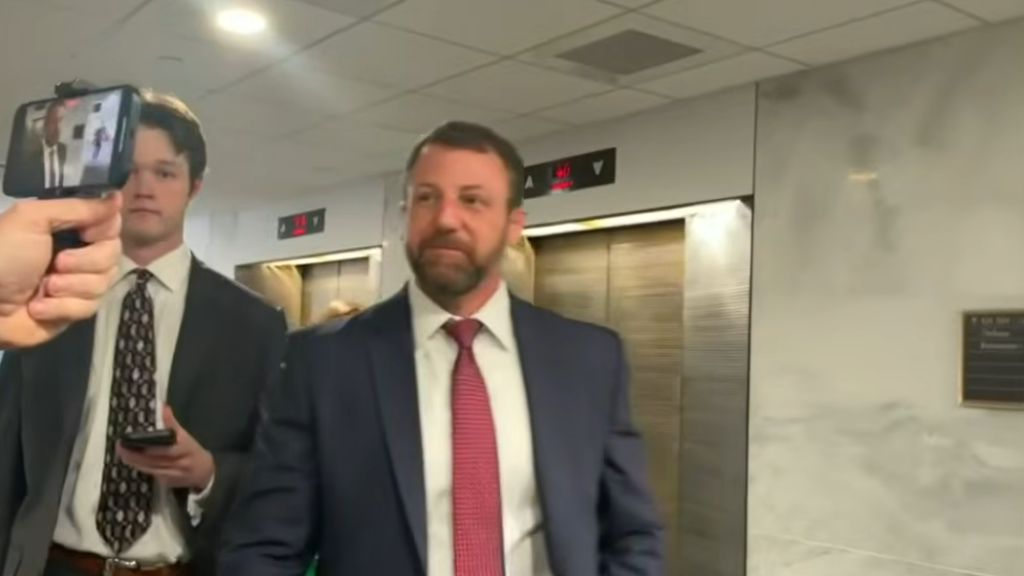
When Markwayne Mullin first arrived at the Department of Homeland Security, his lack of clothing caught people’s attention. Kristi Noem, his predecessor, had made her national debut in a video that featured her ICE-branded bulletproof vest prominently along with words about “dirtbags off the streets.”” Mullin arrived wearing a suit and tie. He uploaded a video in which he praised his staff. He claimed to have “the greatest employees working at DHS ever.” It was a purposeful contrast. It’s another matter entirely if it endures.
On March 27, 2026, Mullin was confirmed and sworn in to take over a department that had spent almost a year making negative headlines, alienating bipartisan allies on Capitol Hill, and overseeing a number of operational failures, from the shooting deaths of two American citizens in Minneapolis during immigration enforcement operations to the bottlenecking of disaster relief funds. After nine days on the job, he began making adjustments. They’re not insignificant, but they’re also more surgical than sweeping, at least for the time being, and some of the people who wanted Noem gone are already pressuring Mullin to act more quickly.
Suits Over Vests: What Markwayne Mullin’s Early Moves at DHS Tell Us About Where Things Are Heading
| Full Name | Markwayne Mullin |
|---|---|
| Title | 9th Secretary of the Department of Homeland Security |
| Sworn In | March 27, 2026 |
| Predecessor | Kristi Noem (fired by President Trump in March 2026) |
| Previous Role | U.S. Senator, Oklahoma (Republican) |
| Also Served | U.S. House of Representatives (Oklahoma) |
| Background | Former MMA fighter; businessman; Cherokee Nation citizen |
| Education | Missouri Valley College |
| Family | Married; multiple children |
| Net Worth (Est.) | Reported in the multi-million dollar range |
| Key DHS Changes Made | Rescinded Noem’s $100,000 contract approval rule; paused mega-warehouse detention projects; reviewing use of DHS aircraft for deportation flights |
| New Contract Threshold | Contracts over $25 million now require DHS deputy secretary approval |
| FEMA Funding Backlog | Approximately $2.2 billion in recovery and mitigation dollars were in the DHS approval queue at time of policy change |
| FEMA Staff Lost Under Noem | Over 2,400 employees |
| DHS Shutdown Duration | 47+ days at time of key policy changes (longest in U.S. history) |
| Disaster Relief Fund Remaining | Approximately $3.6 billion |
| Key Republican Ally | Sen. Thom Tillis (NC); Rep. Mark Amodei; Rep. Carlos Gimenez |
| Bipartisan Reform Bill | Introduced by Rep. Brian Fitzpatrick (R) and Rep. Thomas Suozzi (D) — requiring judicial warrants for criminal arrests, unmasked agents |
| Relationship with Tom Homan | Described as close; unlike dynamic between Noem and Homan |
| Six-Month Goal (Self-Stated) | Stabilize DHS operations and restore public and congressional trust |
On April 2, the first significant action took place. Mullin revoked the directive. In June of last year, Noem instituted a requirement that any DHS expenditure exceeding $100,000 require her personal approval. In theory, this rule seems like a sensible fiscal oversight measure, but in reality, it caused a serious bottleneck throughout the department, particularly at FEMA. Even routine reimbursements had to wait for the secretary’s signature, making it difficult for emergency managers to transfer disaster recovery funds swiftly. By September, the policy had postponed at least 1,000 FEMA contracts, grants, or disaster reimbursements, according to a Senate Democratic report. Two days prior to Noem’s dismissal, Republican Senator Thom Tillis of North Carolina, whose state was still recovering from Hurricane Helene, directly challenged her during a Senate hearing. “You’ve failed at FEMA,” he informed her. She had a difficult hearing.
Mullin’s replacement policy significantly raises the bar: component leaders now handle contracts under $25 million, while the DHS deputy secretary must approve those over $25 million. The modification was commended by the International Association of Emergency Managers, which described it as a “common-sense approach.” When the new policy went into effect, about $2.2 billion in recovery and mitigation funds were in the DHS approval queue. However, the relief from the change won’t be fully felt until the department’s funding standoff, which is currently the longest government shutdown in American history at more than 47 days, is resolved.
The mega-warehouse detention project, an endeavor under Noem to purchase sizable industrial facilities across the nation to house immigration detainees at scale, is also being halted by Mullin. That program’s implementation had been disorganized. Local authorities in places like Oakwood, Georgia, had hardly any prior notice that DHS intended to construct large detention facilities there. B.R. White, the city manager of Oakwood, told CNN that planned meetings with DHS officials had been put on hold under the new administration. Although he expressed cautious optimism, he was realistic about what would be required to restore trust. “Until DHS/ICE proves me wrong,” he stated, “I will work under the notion that their past behavior is an indication of their future performance.”
It’s difficult to ignore how much of Mullin’s early agenda is shaped by his predecessors rather than what he is constructively advancing. The detention warehouse program has been halted, the contract approval bottleneck has been removed, and the use of DHS aircraft for deportation flights has been reviewed. These changes are essentially reversals. In any transition, some of that is normal. However, some Republican lawmakers believe that Mullin is adopting a piecemeal strategy when a more comprehensive reset is necessary.
“Review everything that was being done under Secretary Noem,” Florida Representative Carlos Gimenez, a member of the House committee in charge of DHS, told CNN. “I think a lot of things need to change and hopefully he will be the agent of change.” Representative Brian Fitzpatrick, a former FBI agent who collaborated with Mullin while they were both in the House, went one step further and introduced a bipartisan bill with Democratic representative Thomas Suozzi that would mandate judicial warrants for criminal arrests and require ICE agents to remove masks in the majority of cases. Susan Collins, the chair of the Senate Appropriations Committee, has at least given the bill a sympathetic ear, but it is unclear if it will pass.
The dynamic between Homan and Noem seems to be very different from that between Mullin and Tom Homan, the border czar who has been one of the most prominent figures in Trump’s immigration enforcement. According to sources, the two have a close working relationship, which is noteworthy considering the conflict that marked DHS’s internal operations under the previous administration. Before Mullin officially took over, Homan had already started implementing some of his own changes in Minneapolis, such as putting an end to roving patrols, installing body cameras, and bringing in leadership that could reduce tensions.
When one looks at all of this from the outside, one sees an organization in true institutional distress, run by a person who appears to be aware of the scope of the necessary repairs but is juggling intense conflicting demands. The fundamental immigration agenda of the Trump administration remains unchanged. Mullin has made it apparent that he plans to carry out deportations. However, he seems to have come to the conclusion that his predecessor’s tactics and management style were causing more issues than they were resolving, including for FEMA, congressional relations, public opinion, and most likely the operational efficacy of ICE itself. The question that will define his early tenure is whether that instinct results in a more long-lasting reset for DHS or if it is overshadowed by the political pressures of upholding Trump’s enforcement posture. It’s really hard to tell which way it will go.
