

If you’re watching quickly, it’s easy to miss an early scene in Cobra Kai. When Eli Moskowitz enters a dojo for the first time, he doesn’t really seem to belong there. He is a quiet, awkward teenager who flinches when someone raises a hand close to his face. His scar from a cleft lip attracts unwanted attention. He doesn’t say much. Something changes when Johnny Lawrence instructs him to change the script. It’s the start of Falcão, but it’s a minor moment in a show full of larger ones.
Actor Jacob Bertrand plays Eli Moskowitz, also known to Cobra Kai fans worldwide as Hawk (or Falcão in Portuguese-speaking markets). Bertrand began the series as a recurring character and was promoted to the main cast by season two. It was a logical promotion. In a way that supporting characters seldom do, Bertrand’s character was attracting attention. The mohawk came first, followed by the assurance, the violence, and finally—and this is what really made Falcão fascinating—the regret.
Falcão’s arc deviates from the typical Cobra Kai pattern of a fighter becoming good or bad depending on who is teaching them, which distinguishes him from the majority of the show’s cast. There is more to his metamorphosis than that. He had never felt more confident than he did under Johnny Lawrence.
That self-assurance turned into something more repulsive under John Kreese: an insatiable need to prove oneself. As you watch him in seasons two and three, it seems more like Kreese took advantage of an existing wound rather than creating a monster: a boy who had been rejected his entire life and was now overcompensating so much that he was unable to recognize what he was becoming.
The low point is distinct and unforgettable. Falcão, in an act of petty cruelty disguised as allegiance to Cobra Kai, chops off his best friend Demetri’s mohawk. Not because it’s violent, but rather because it’s so familiar, it’s one of the series’ more unsettling scenes. A dojo is not necessary for that specific type of betrayal, which is carried out to feel powerful over someone you genuinely fear losing. In a karate gi, it’s just common human weakness.
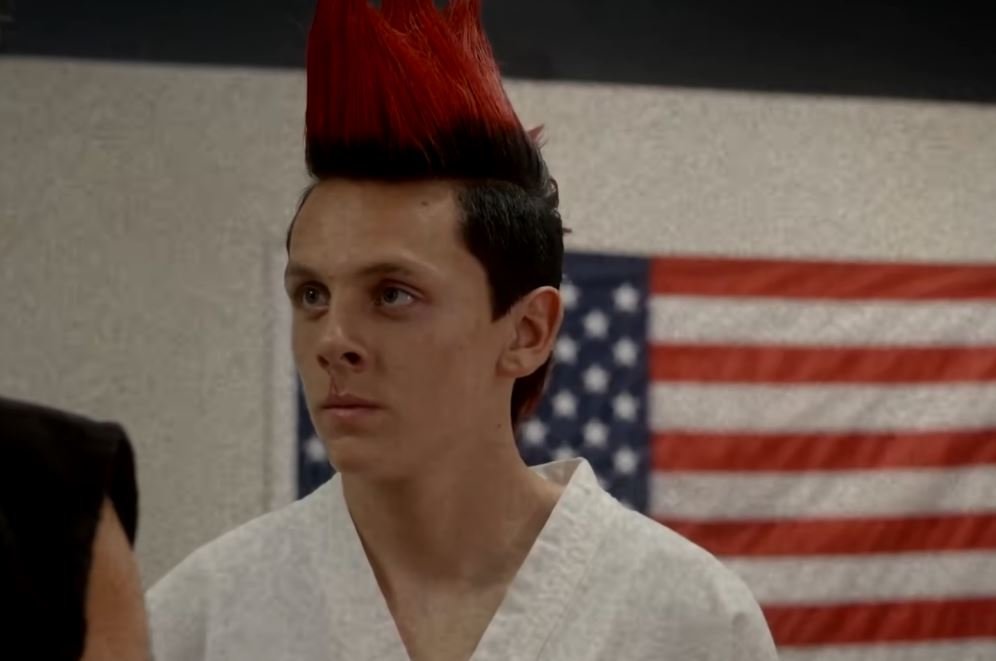
His eventual redemption merits a place in the narrative. He doesn’t instantly turn heroic and change sides. Given what he did to that mohawk in the first place, it is fitting and subtly humorous that he completely gives up karate for a while, loses the mohawk, and needs Demetri to pull him back in. As a Miyagi-Do student, he eventually prevails in the All Valley boys division in 2019, but the outcome is different from a standard tournament victory. It ends as a personal, rather than merely competitive, conclusion.
It’s difficult to ignore how skillfully Bertrand portrays the character’s quieter side. It’s simpler to play the boisterous, combative Hawk from seasons two and three because of his swagger and obvious drive. It’s more difficult for the Hawk of later seasons to try to mend the friendships he destroyed and discover that some people are more forgiving than he anticipated. Compared to the tournament scenes, the scene where he and Demetri announce they will be attending Caltech together—the two of them referring to themselves as the Binary Brothers—is smaller and more subtle.
Eli Moskowitz has traveled farther than nearly every other character on the show by the end of the series. At first, the world told him he didn’t belong. He first developed the wrong kind of confidence, then the right kind, and ultimately developed into a person who could create genuine things, such as a friendship, a future, and a version of himself that didn’t need a mohawk to feel authentic. Fundamentally, Falcão’s story is about what it costs to change who you are and whether or not people who once knew you still recognize you. For six seasons, it would be worthwhile to pursue that question.
