

Soldiers at Fort Hood in Texas were going about their daily business early on November 5, 2009. They were in line inside the Soldier Readiness Processing Center, a sizable facility where soldiers awaiting deployment receive their immunizations and physical examinations prior to being sent out. It was routine, crowded, and procedural. Then 39-year-old Army psychiatrist and major Nidal Malik Hasan got up, yelled “Allahu Akbar,” and started shooting at defenseless, unarmed men and women.
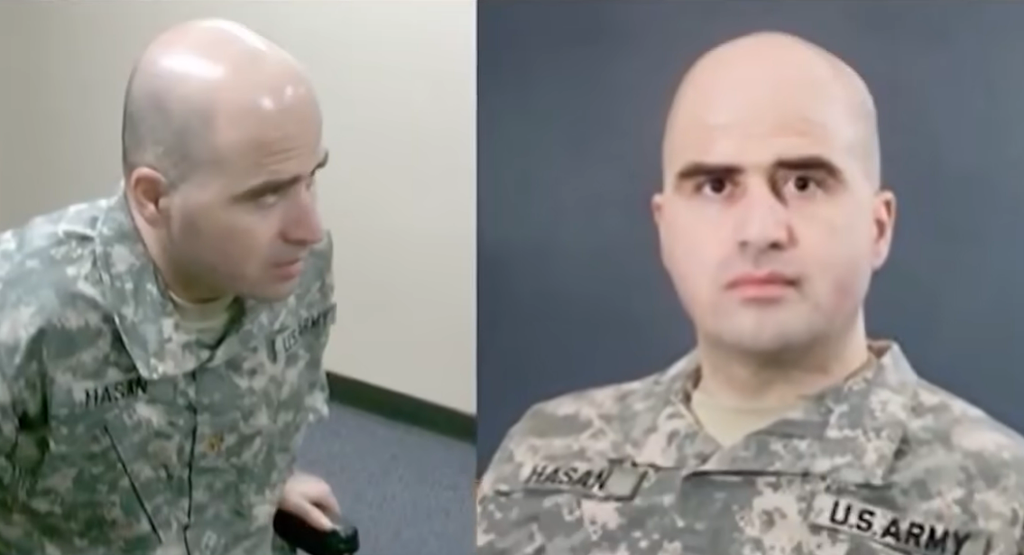
Thirteen soldiers were killed and thirty-two more were injured by the time the shooting stopped, which didn’t stop until a civilian police officer shot Hasan, paralyzing him from the waist down. It is still the deadliest non-combat assault on a U.S. military installation.
| Full name | Nidal Malik Hasan |
| Date of birth | September 8, 1970 |
| Age | 56 years old |
| Place of birth | Virginia, United States |
| Ethnicity/background | American of Palestinian descent |
| Military rank | Major, U.S. Army |
| Role in the military | Psychiatrist, U.S. Army Medical Corps |
| Date of attack | November 5, 2009 |
| Location of attack | Fort Hood, Texas — Soldier Readiness Processing Center |
| Casualties | 13 killed, 32 injured |
| Significance | Deadliest non-combat attack on a U.S. military base in history |
| How shooting ended | Civilian police officer shot Hasan; left him paralyzed from the waist down |
| Court-martial | August 2013 — represented himself; admitted to being the gunman |
| Stated motive | Said he was protecting Muslims and the Taliban from U.S. military operations |
| Sentence | Death penalty |
| Execution method approved | Firing squad |
| Scheduled execution date | December 3, 2026 |
| Execution location | Fort Hood, Texas |
| Who approved the execution | Defense Secretary Pete Hegseth (recommendation); President Donald Trump (approval) |
| Historical significance of execution | First U.S. military execution by firing squad since World War Two; first military execution in over 60 years |
| Current status | One of four inmates on U.S. military death row |
| Education | Virginia Tech, Uniformed Services University (medical school), William Fleming High School, Wakefield High School |
On September 8, 1970, Hasan was born in Virginia to parents who were immigrants from Palestine. He completed his education in the United States, graduated from Virginia Tech, went to the Uniformed Services University for medical school, and joined the U.S. Army Medical Corps as a psychiatrist. His career path appeared to be one of professional success and integration. In actuality, for years prior to 2009, something was changing beneath that surface. Later, coworkers expressed worries about remarks he had made. He allegedly gave a talk at Walter Reed in which he expressed sympathy for suicide bombers instead of discussing a clinical subject. For reasons that caused long-lasting institutional embarrassment, warnings were raised and then mainly ignored.
Hasan represented himself in court. He freely acknowledged that he was the shooter. He claimed to have carried out the attack because he thought he was shielding Muslims and the Taliban in Afghanistan from American military operations during his court-martial in August 2013. He expressed regret for “any mistakes,” using his own words, which many saw as more defiant than repentant. He received the death penalty after being found guilty on all charges of premeditated murder. Since then, he has been placed on military death row.
The families of those killed at Fort Hood waited for seventeen years. Legally, the president must approve military executions, and the procedure entails a protracted appellate review. The military death penalty was declared unconstitutional by the U.S. Court of Appeals for the Armed Forces in 1983, but Ronald Reagan reinstated it the following year. As the years passed, Hasan sat in a cell while the legal system worked slowly. Reading the testimonies of survivors and the families of the victims gives the impression that the delay exacerbated an already severe injury. These soldiers were killed in a processing center on American soil by a man they had no reason to fear, despite having survived combat zones, training mishaps, and the daily grind of military life.
The Pentagon declared on October 6, 2026, that President Donald Trump had approved the execution after Defense Secretary Pete Hegseth recommended it. It was scheduled to take place at Fort Hood on December 3, 2026. It will be the first military execution of any kind in decades, and the first by firing squad since the end of World War Two. On social media, Pentagon spokesperson Sean Parnell succinctly stated, “Judgement day for Hasan has finally come.”
In the US, firing squads are uncommon. Last year, South Carolina conducted one, which was both the state’s first and the nation’s first application of the technique in fifteen years. When it comes to the military, the decision carries a lot of weight: soldiers shooting at someone who used to wear the same uniform, carrying out a sentence that has been in the works for years, in the state where the crime was committed.
It’s important to understand what this case has always been. Hasan wasn’t a lone actor with mental instability acting on impulse. He bought a laser-sighted handgun, planned the assault, and selected a site where soldiers would be unarmed. He testified in court that he did it to defend an enemy combatant force engaged in combat with the US military. For years, the families of the 13 deceased have argued, with good reason, that their losses should have been categorized as combat-related deaths rather than workplace violence. This distinction had an impact on benefits and recognition. They have never been completely satisfied with the resolution of that dispute.
The calendar now shows the date. It remains to be seen if the legal process continues through December; last-minute challenges and appeals are always a possibility. However, there is a specific date, a specific method, and a specific location for the first time in a long time. It has been a long time coming for those who experienced November 5, 2009, or who lost a loved one on that day.
