

Two minutes into their final game at the Sekai Taikai, Sensei Wolf scores the first point with such casualness that it almost seems dismissive. No festivities, no recognition. He simply resets his posture and gives the impression that he already knows how this will end. Standing at the opposite end of the mat, Johnny Lawrence appears to think the same thing.
That’s why what came next was so surprisingly fulfilling. By the time Cobra Kai’s Netflix series finale debuted in February 2025, the show had spent six seasons meticulously—and occasionally painfully—reconstructing Johnny Lawrence from the man who was crane-kicked in the face in 1984 into someone who was deserving of a prize. The show had been building toward the battle with Wolf, the Iron Dragons’ unbeaten and technically superior sensei. And it did, albeit probably not in the manner that most people had anticipated.
Early on, Johnny lost 2-0. Wolf, who had already humiliated him in a locker room altercation shortly before the fight, was dissecting him with precise technique and the icy efficiency that comes from someone who has never had to question their own abilities in a fight. Daniel’s typical motivational speeches weren’t getting through. Johnny appeared shaken in a way that was real rather than dramatic.
It wasn’t a sudden burst of superhuman power that altered it. Daniel was pulled aside by Chozen, who reminded him that Johnny reacts to challenges rather than gentle encouragement. Daniel then gave, of all things, a speech in the vein of Kreese. Direct and brutal. There is no room for doubt. It also made perfect sense for the character based on the way Johnny’s face changed when he heard it.
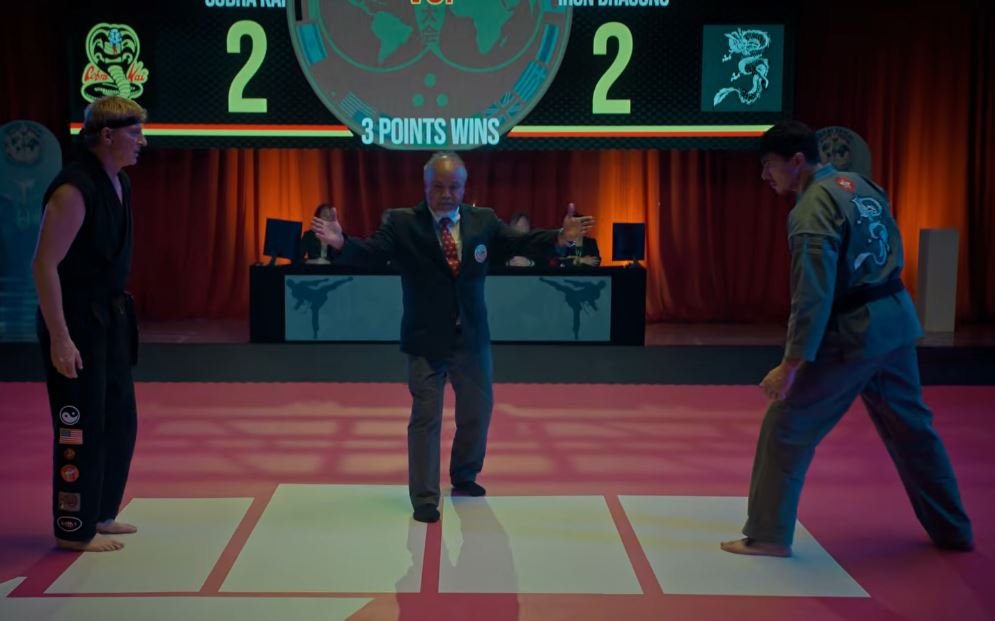
When he returned, he began fighting in a different way. For the first point, a spinning sidekick. For the second, he taught his students the same flying tornado kick from season four. It was 2-2 all of a sudden, and something had changed in the arena.
The show never pretended that Wolf lacked talent, making him a genuinely fascinating character. By most conventional standards, he was superior. In their previous meetings, he had physically outmatched Johnny with little apparent effort, and he had more tournament experience and decorated credentials. Even Johnny acknowledged that Wolf was the better fighter. That admission felt genuine rather than like humility crafted for dramatic effect.
However, Wolf’s habit cost him. He teased rivals. He seemed to care more about humiliating his opponent than winning, so he went for illegal strikes rather than because he had to. This franchise has a pattern where the more dangerous fighter loses because cruelty becomes a distraction from just winning the fight, as Mike Barnes did to Daniel in The Karate Kid Part III. Wolf knew full well that using the Shaolin Sunset, a prohibited move, could result in disqualification. He had no intention of scoring a point. He was attempting to cause harm to someone.
Daniel called a timeout prior to the last point. He brought back memories of 1984 for Johnny: rushing in without thinking, running directly into the crane kick, and allowing aggression to take precedence over awareness. Johnny had a clear flashback to that moment. Then he returned to the mat and did the exact opposite of what the Cobra Kai philosophy had always advocated: he waited. He allowed Wolf to approach him.
Wolf lunged forward. Johnny found the opening, dropped low, deflected the subsequent blow, and ended the fight with a spinning backfist.
It’s still worthwhile to consider whether Wolf would have treated Johnny differently in more stringent circumstances without a referee or tournament regulations. Most likely. The altercation in the locker room and the previous altercation in which Wolf managed to hold his own against Daniel and Johnny at the same time indicate that he had more in store. However, the competition was the competition, and the outcome was the outcome.
The victory was never meant to be about establishing that Johnny was the best fighter in the room, as the show realized and the fight demonstrated. It was to demonstrate that he had gained knowledge. That he could trust people who believed in him even when he wasn’t sure he believed in himself, stop acting on his worst impulse, and accept assistance without feeling diminished by it. The first two points went to Wolf. The final three were taken by Johnny. That’s the winner.
