

When a show stumbles through the hallway and lands, there’s a certain kind of satisfaction. That’s exactly what Netflix’s remarkably resilient The Karate Kid sequel series, Cobra Kai, accomplished. Season 6 was bloated, with fifteen episodes spread over nine months and divided into three sections. At times, it seemed as though the showrunners were cutting back on story to appease the algorithm. However, on February 13, 2025, the finale truly delivered something uncommon: an ending that felt earned rather than staged.
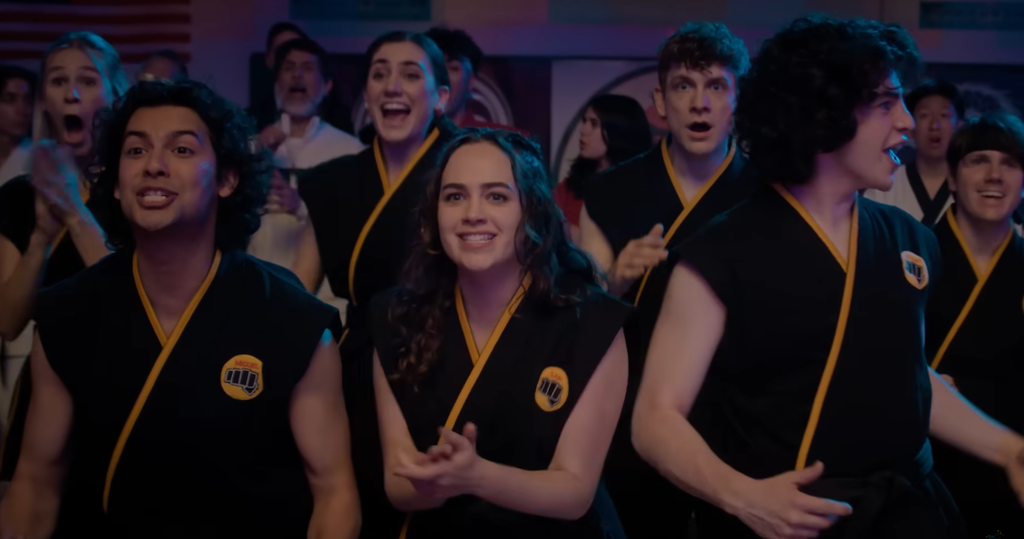
The action returned to the All Valley Sports Arena in San Fernando Valley, California, where it all started in the last few episodes. Just that decision suggests something deliberate. It’s a familiar gymnasium with forty years of personal history, not a grand international venue with the drama of Barcelona still resonating. Returning home felt right for a show that has always recognized nostalgia as its most potent currency.
Although there is a lot of spectacle, it is not what makes the Cobra Kai ending compelling. It’s the underlying, more subdued emotional reasoning. The most complex antagonist in the series, John Kreese, makes a last-minute decision to atone for three and a half decades of wrongdoing by apologizing to Johnny Lawrence. He even returns Cobra Kai to him. This scene has the potential to devolve into melodrama. It doesn’t, for some reason.
The departure of Samantha LaRusso merits special attention. Miyagi-Do is essentially eliminated from competition when she declines to compete against her best friend Tory in the semifinals. It was deemed frustrating by some viewers. Maybe they didn’t get the point. Sam’s decision isn’t a sign of weakness; rather, it’s the show’s most obvious declaration that winning wasn’t always the whole point. Sam and Robby, played by Mary Mouser and Tanner Buchanan, respectively, are involved in real life, and their characters’ farewells have a warmth to them that seems real rather than staged.
To be honest, the climax is a little ridiculous. The senseis battle to determine the title if Cobra Kai and the Iron Dragons are tied. William Zabka’s Johnny Lawrence, 59, will take on Lewis Tan’s Sensei Wolf, who is in his 30s. On paper, absurd. Nevertheless, there’s something poignant and difficult to dispute about Johnny’s eventual victory, which he achieved by applying the very principles Daniel taught him decades ago: balance, patience, and allowing the opponent’s aggression to be their undoing. In the most shameless way imaginable, it’s crowd-pleasing.
Miguel Diaz, who has been the show’s real Karate Kid since he first used a crane kick in season one, also receives his just desserts. He overcomes Axl and preserves Cobra Kai’s life long enough for the sensei confrontation to take place. It seems as though the authors were always aware that Miguel was the younger generation’s emotional focal point. In those last scenes, Xolo Maridueña exudes the quiet confidence that the part required.
Reasonable closure is given to the remainder of the graduating class. Away from the ring, Robby finds serenity. As the unlikely comedic anchors of the show become true friends, Hawk and Demetri move on. Tory, whose storyline throughout the series was perhaps the most complex of the younger cast, eventually develops a genuine relationship with Robby in competitive karate. For some people, it’s not a fairy tale exit. However, it’s truthful.
In the end, the Cobra Kai conclusion realizes that Johnny Lawrence’s story was never truly about karate. It told the story of a man who peaked at seventeen, carried the wrong version of himself for decades, and eventually, slowly, messily, imperfectly, discovered who he was meant to be. In 2025, he triumphs in the same arena where he lost in 1984. Not because he was owed one by the universe. because he worked hard.
It’s the kind of conclusion that doesn’t require praise. Simply put, it is.
