

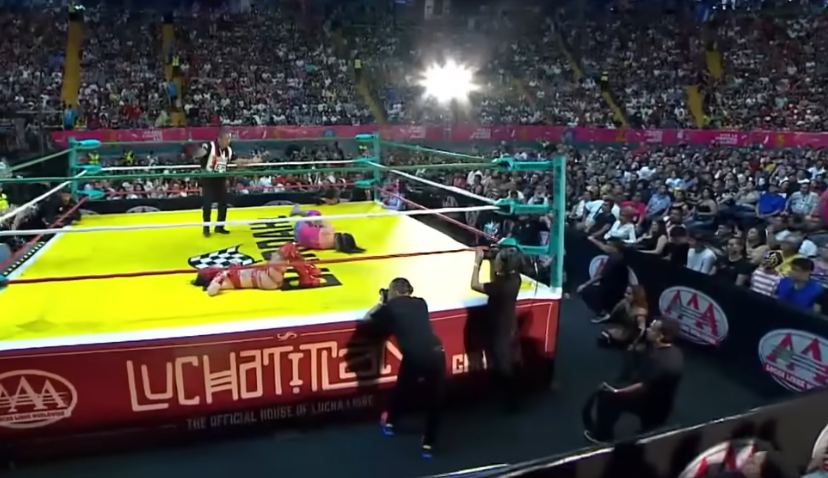
Before you even see the ring, there’s a certain sound that greets you at Arena México: a combination of heckling, whistling, and the clink of micheladas being passed down rows of plastic seats. It’s Friday nite in the Doctores neighborhood, and this has been the norm for decades. Here, lucha libre mexicana is not so much performed as it is inherited, passed down the same way a family recipe is passed down, slightly altered but always recognizable.
Most fans are unaware of the sport’s longer history. Its origins can be traced back to Greco-Roman wrestling, which was filtered through British wrestling in the 18th century before being transported across the Atlantic and eventually south into Mexico as fairground entertainment. When Antonio Pérez de Prian opened a wrestling gym in Mexico City in 1863 under the name El Alõdes Mexicano, he is credited with sowing the first true seed. A man using the name of a Greek hero to market a foreign sport to a new nation is a minor, nearly forgotten detail. However, it was successful. Mexico had its first national wrestling champion by 1903.
But Salvador Lutteroth González, who established the Empresa Mexicana de Lucha Libre in the early 1930s, is largely responsible for the sport as we know it today. The fights that pack Arena México’s 16,500 seats are still staged by that company, which is now called CMLL. That continuity has an almost stubborn quality. In the United States, wrestling promotions have folded, combined, and changed their names a dozen times. CMLL simply continued.
The mask is what truly distinguishes lucha libre mexicana, not the wrestling itself. Early in the sport’s history, masks were used, and their significance is difficult to fully convey to an outsider. They’re not parts of a costume. If someone is completely removed during a match, they will be disqualified. Here, the tradition takes identity very seriously. A wrestler’s mask is frequently referred to as his most valuable asset, and losing it—that is, actually losing it in a mask-versus-mask match—can signal the end of a character’s career. Even as a first-time spectator, it’s difficult to avoid feeling as though something tangible is on the line, even inside the entire theater.
The action itself favors speed over force. Compared to their American counterparts, Mexican luchadores are typically smaller and more acrobatic, preferring aerial moves off the ropes over grinding power holds. The rings themselves, which usually lack the spring supports used in American and Japanese wrestling, are partly to blame for this. Therefore, the large, spectacular falls take place outside the ring, where a luchador can fall and absorb the impact. It’s a practical detail that created an entire aesthetic—a phenomenon that occurs more frequently in sports than people realize: necessity becoming style.
Then there is the audience itself, where the social logic of lucha libre is revealed. The arena becomes hostile almost instantly when a Rudo, dressed in dark clothing, enters first. Children who were fidgeting suddenly brighten when a Técnico shows up a few minutes later. Even though everyone in the building is aware that it is staged, the real-time display of good versus evil is applauded and jeered with complete sincerity. One could argue that this is precisely why it works: the emotional participation isn’t fixed, but the outcome is.
Additionally, tag matches are conducted differently here; typically, there are three or four wrestlers on each side rather than two, and pins can land on captains or occur simultaneously in ways that would appear chaotic in an American ring. It’s more about prolonged spectacle than it is about racing to tag a partner. The government of Mexico City officially recognized lucha libre as an intangible cultural heritage in 2018. This may sound bureaucratic, but imagine spending a Tuesday nite in Arena Coliseo with people who have been there since childhood. They weren’t particularly surprised by that acknowledgment. It simply confirmed what the audience already thought.
