

There’s a certain kind of TV moment that takes you by surprise. Maybe not because of a big explosion or a plot twist, but because an actor walks into a scene and owns it. When Thomas Ian Griffith came back as Terry Silver in Season 4 of Cobra Kai, that’s what happened. For people who saw the first three Karate Kid movies, it was like seeing a door open after being shut for thirty years.
Gibbs played Silver for the first time in The Karate Kid Part III in 1989. The character was smooth, crazy, and dripping with Reagan-era excess. He was a wealthy Vietnam veteran-turned-businessman who paid for a teenager to get even over a karate tournament. It wasn’t quite Shakespeare. Griffith, on the other hand, leaned into it with a certain theatrical intensity that stuck with people even after the movie itself was thrown out.
It wasn’t just a dust-off job when Josh Heald, Jon Hurwitz, and Hayden Schlossberg, the people who made Cobra Kai, finally brought him back. They gave Griffith something more interesting: a history, a mind, and a reason to exist besides being a cartoon bad guy in the first movie. That kind of question, “What has that guy been doing for the last 30 years?” sounds easy, but you need to write well to answer it. It’s clear they thought about their answer because of what ended up on screen.
What makes Griffith’s role in Cobra Kai unique is that Silver is now more than just dangerous; he seems real. The drug-fueled acting in the 1989 movie has been replaced by something calmer and scarier: control. It looks like Silver has spent years learning how to hide what he can do as he walks into a room. That’s more difficult to play than pure menace. Griffith does it with an air of stillness that seems real. Early in the season, Silver is in his wine cellar by himself and kicks a bottle off its base into the wall. This one scene says more about the character than a dozen lines of dialog.
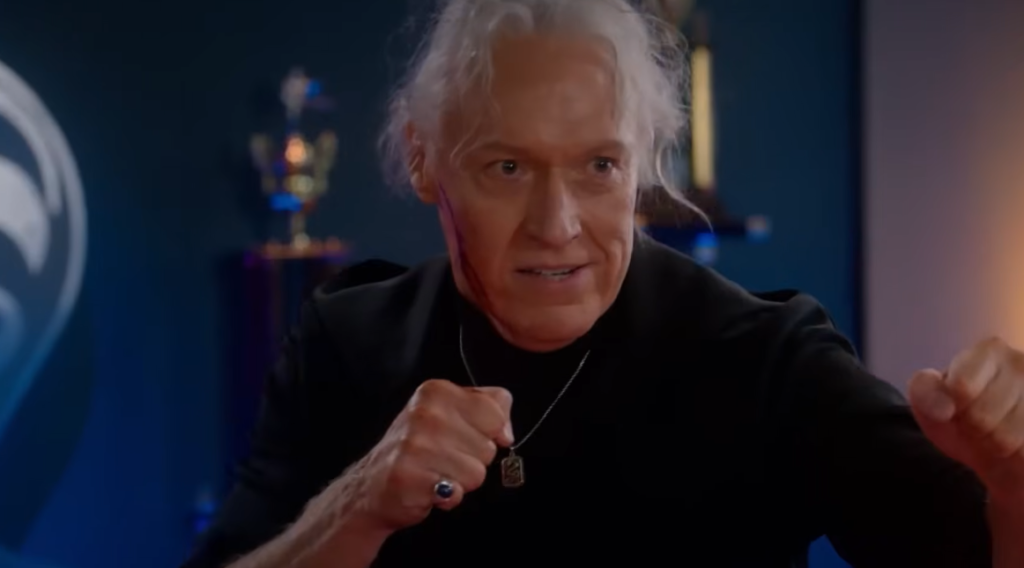
It’s important to remember that Griffith was never just an action star. He learned martial arts when he was young and got his black belt when he was seventeen. Before Hollywood came calling, he also spent a lot of time in theater. In the early 1990s, critics were comparing him to a wide range of actors, from Jean-Claude Van Damme to Clint Eastwood. This was a strange range, but it made sense because he was good at both fight scenes and emotional scenes. The mainstream fame that seemed like it would happen never really did. That’s maybe why the Cobra Kai arc feels like a long-overdue settling of scores.
For forty years, Ralph Macchio has been a part of this franchise and said, “Thomas is knocking it out of the park.” That’s not advertising language from a cast member. That sounds like it was written by someone who saw another actor work on set and was truly impressed. Macchio said that Griffith’s return gave not only Silver but also the whole season more layers and depth. He said that Griffith’s return brought back threads from the old movies and put them in new situations that made the original trilogy feel more complete now. That might be the best thing that Cobra Kai has ever done: it has made older, flawed movies look like they were building up to something better the whole time.
Griffith himself said that meeting Macchio again on the set was strange because it was like two men standing next to each other after thirty years and feeling the weight of something strange and specific. In the background, three adults who work full-time were acting like fans while the show’s creators were filming on their phones. That picture really makes me think of a person.
In the end, Thomas Ian Griffith’s run on Cobra Kai shows that second chances in Hollywood aren’t always about the actor making things right; sometimes they’re about giving a character a chance to finally breathe. Terry Silver should have had a better story in 1989. He got one.
