

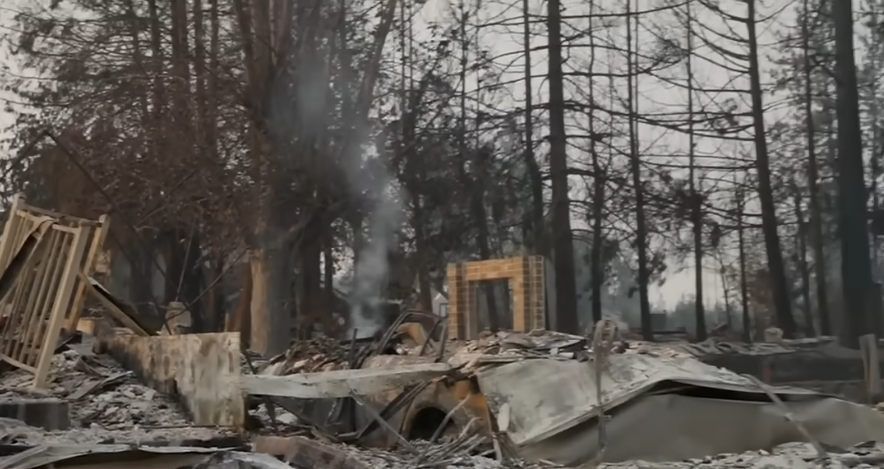
Anita Stokes took her cats, some clothes, and her wedding album with her when she left her Spokane home last Saturday. She found herself in front of an ash pile by Tuesday. That was all that was left. “I don’t think it’s sunk in yet,” she remarked. At that point, it’s difficult to know what else someone should say.
Even seasoned emergency personnel were taken aback by the speed at which the three distinct wildfires in Washington state, known as Old Trails, Autumn Lane, and Fairview, spread on August 1. Strong, dry winds fueled the fires, which destroyed about 850 buildings and burned about 10,500 acres as they tore through neighborhoods north and west of Spokane, the second-largest city in the state. They were mostly houses. In a matter of hours, entire residential streets were reduced to twisted metal and scorched foundations.
At the peak of the crisis, about 67,000 people were evacuated. The population of a mid-sized American city is uncomfortably close to that figure. At one point, fourteen people were reported missing, but they were all eventually found. Officials keep bringing up the fact that no deaths have been confirmed, almost visibly relieved because the speed of these fires made a worse outcome seem completely plausible.
The arrest of Aaron Farinacci, a 37-year-old man suspected of intentionally starting the Old Trails Fire, the most destructive of the three, added a somber element to an already challenging situation. Just before flames appeared, witnesses reported seeing him kneeling close to grass and appearing uneasy. He is currently accused of first-degree arson. There is an unsettling question surrounding the entire situation because the causes of the other two fires are still being investigated.
Over 4,000 firefighters from 12 states and even Australia worked through the night to build containment lines around each of the three fires. Midweek cooler temperatures were beneficial. Tom Stokesberry of the California Interagency Incident Management Team 7 stated, “The fires did not grow,” in a straightforward manner that gave the statement a sense of importance. Stokesberry, however, was cautious not to declare victory. He is aware of what is about to happen. By the weekend, temperatures are predicted to return to the upper 90s, with decreasing humidity and rising wind. The real test will be on Friday and Sunday.
FEMA assistance and federal resources for Washington and neighboring tribal nations were made available by President Trump’s authorization of a federal emergency declaration. This week, Microsoft’s AI for Good Lab, Amazon, Boeing, and F5 all announced assistance or support initiatives. Over 26,000 emergency supplies, including air purifiers, hygiene kits, gloves, and firefighter hydration packets, are being delivered by Amazon via the Red Cross and regional nonprofits. Boeing used its Charitable Trust to pledge $250,000. These are significant reactions, but it’s also important to acknowledge that corporate generosity doesn’t fully kick in until 850 buildings are destroyed.
Not enough attention is paid to the animals caught in all of this. In the streets surrounding the Old Trails burn area, volunteers spread water and cat food. Pets waiting to be reunited with their owners were housed in the local Humane Society shelter. A microchip allowed a cat to be reunited with its family in less than an hour. Stokes’s own cat did not survive. She has three left.
It’s important that containment lines are now in place. However, one incident commander simply stated that fire is “a very unpredictable thing.” The upcoming weekend will reveal a lot about whether this week’s work was successful or if Spokane is on the verge of experiencing it again. That uncertainty is real for the thousands of people who are still staying in evacuation sites throughout the city and parked in trailers. Every morning when they wake up, they think about it.
