

Writing about Eugenia Cooney is incredibly awkward. Not because the story is particularly complex, but rather because it seems like writing about her—pointing a camera at someone who already has too many of them—might contribute to the issue. However, it’s probably worth enduring that discomfort. Because it addresses what makes her story so difficult to look at and even more difficult to ignore.
Born in Boston in 1994, Eugenia Sullivan Cooney grew up in Connecticut and discovered the internet before it really knew what to do with people like her. She began livestreaming in 2011, posted early videos that together garnered millions of views, and progressively developed a fan base centered around a very particular style: elaborate emo-style makeup, long dark hair, and gothic lace. On camera, she was endearing and quiet. She was also noticeably extremely thin, and for better or worse, that fact came to define everything she did.
18,000 people had signed a petition to ban her from YouTube by 2016. Her appearance, according to critics, was serving as what online communities refer to as “thinspiration”—a term from pro-eating disorder spaces where dangerously underweight photos circulate as inspiration or validation. For her part, Cooney claimed she had no intention of hurting anyone. There is no reason to question that. However, intent and impact are two different things, and the distinction is often overlooked on platforms that aim to maximize viewing time.
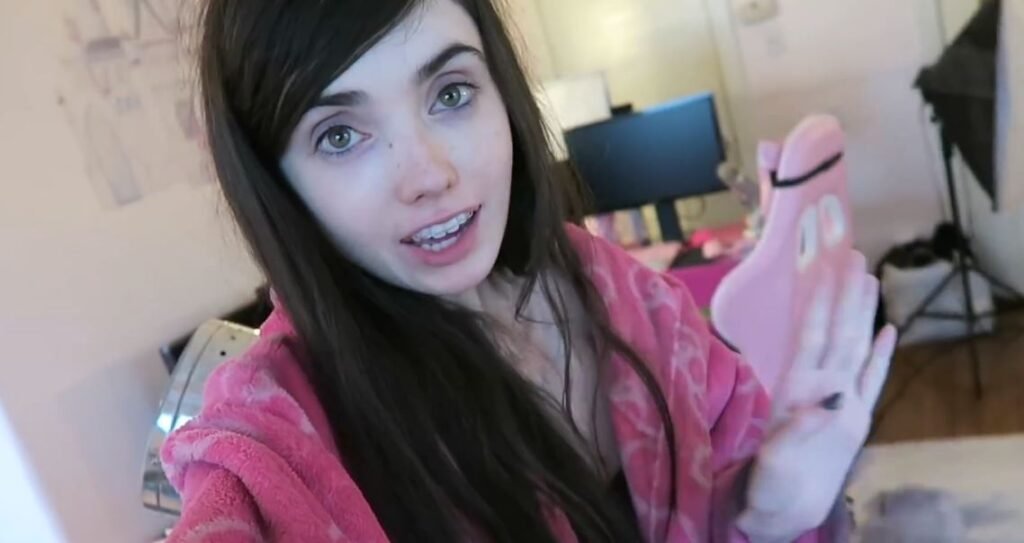
Whether she is a positive or negative influence isn’t really the more intriguing tension in her story. It’s about the gaps in how platforms manage health and harm that are revealed by her ongoing online presence. Each of these platforms—YouTube, Twitch, and TikTok—has content policies, community guidelines, and whole teams devoted to enforcement. However, there hasn’t been a definitive response to the question of what to do about Eugenia Cooney for more than ten years. There have been sporadic petitions. Her stories have persisted. In interviews, mental health professionals have voiced concerns. The comments continue to come in.
In just one month, Shane Dawson’s 2019 documentary about her comeback to YouTube after a hiatus received over 27 million views. For the first time, she publicly acknowledged that she had been battling an eating disorder. Then, there was a real moment when it appeared as though something might change. Her candor was commended. At the 2020 Shorty Awards, she received a nomination for YouTuber of the Year. However, the acclaim was fleeting. Months later, worries reappeared.
It’s possible that the internet isn’t structurally suitable for this conversation or for her recuperation. Support is not the same as witnessing someone suffer in front of hundreds of thousands of people in real time. In fact, it could be the opposite. Even when public pressure campaigns and deplatforming debates are well-intentioned, mental health professionals who study eating disorders are generally clear that they rarely benefit the person at the center of them.
As of 2025, Cooney still has millions of followers on TikTok, more than 2 million YouTube subscribers, and enough of a following that her sightings at airports result in media attention. She no longer streams as frequently. In forums, comment sections, and subreddits, supporters and detractors are still debating her circumstances. The cycle is now practically ritualistic.
Her story uncomfortably and persistently highlights a gap in how online platforms simultaneously consider vulnerable audiences and vulnerable creators. She is more than just a warning story. She is a real person who has little interest in finding a solution to the predicament that the internet helped to create. That’s the part to keep in mind.
