

NASA’s Curiosity rover rolled into a valley called Valle Grande on June 19 and 20, 2026. These were the 4,930th and 4,931st days of its mission on Mars. Inside, the science team found something that stopped them in their tracks. There were honeycomb-shaped cracks in the rusty Martian surface that went all the way across the ground in front of them. Each polygon was about 1.5 to 3 inches across. As far as Curiosity’s cameras could see, there were hundreds or even thousands of them, spread out like geometric wallpaper.
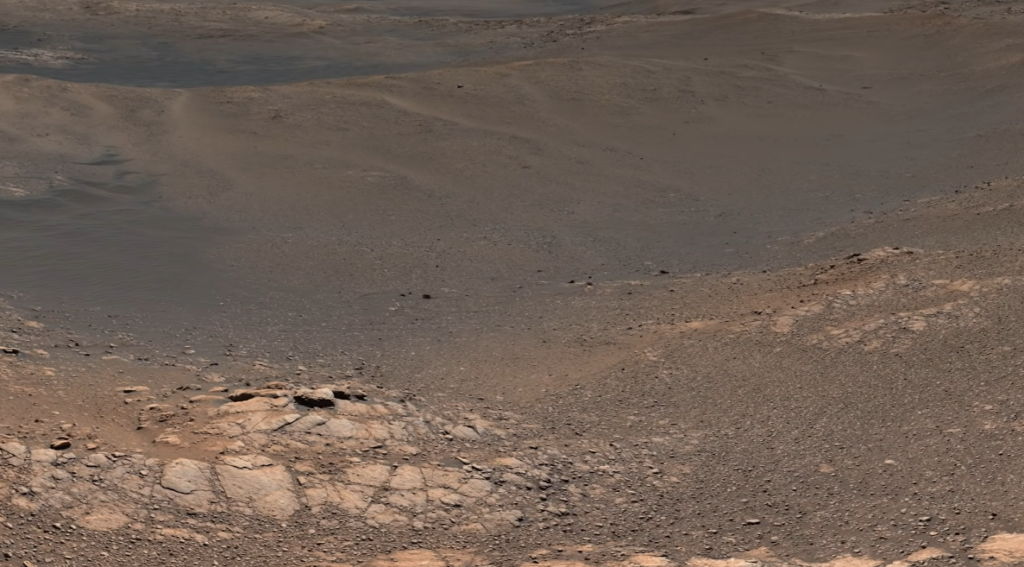
“This sea of polygons took our breath away,” said Ashwin Vasavada, the mission’s project scientist at NASA’s Jet Propulsion Laboratory. “We’ve seen a lot of interesting landscapes through Curiosity’s eyes.” It’s important to pay attention when scientists use that kind of language because it’s not all the time.
Different parts of Mars have been visited by Curiosity before, where it has seen polygonal features. But never this big and never so close together. The team put together a 360-degree panorama from 340 separate pictures. It shows the cracks going around a sand-covered butte they’ve named “Miraflores.” Miraflores is a geological mound that’s about 20 feet tall and sits in the middle of this strange geometric plain. There is a sense that something is planned about the whole scene, but it’s very likely not.
Why does this patterning happen? Scientists are still looking into that part and are being careful not to draw any conclusions just yet. On Earth, hexagonal or polygonal cracks can be found in permafrost terrain, lava that has cooled, and dried lake beds. These are all places where material was stretched or squished and pulled apart in a fairly even way. Drying sediment, cycles of thermal expansion and contraction, compression from burial, or water being sucked out of rocks over long periods of time are the most likely causes on Mars. It’s possible that more than one process played a part. The chemistry information that Curiosity gathered on the spot might help narrow it down, but the team isn’t saying for sure yet.
When you look at these pictures, you can’t help but think about how Mars used to be. Since 2014, the rover has been climbing the foothills of Mount Sharp, a three-mile-high mountain that rises from the floor of Gale Crater. Each level of the climb tells a different part of the planet’s geological history. These layers show an ancient environment that was wetter, had more chemicals, and in some ways was better for life’s basic chemistry. Curiosity has already found sulfur crystals, carbon-based organic molecules, and mineral signatures that are linked to water that is still. The polygons are part of a bigger picture of a surface that is very different from what it was like in the past. It is now dry and irradiated.
Even before the science is clear, what Curiosity found seems important because of how regular it looks. Patterns that repeat at the same size tend to be caused by consistent processes. On a planet that scientists are still trying to figure out, they need more consistent processes. Geography has shown that Valle Grande is not the first place on Mars where history may be buried. But it might be the clearest example yet of how that history is written across the whole valley floor and ready to be figured out.
Curiosity has been on a mission for 14 years, even though it was only supposed to last two. The rover keeps going up and down, taking pictures, and finding new things that no one expected.
| Detail | Information |
|---|---|
| Discovery | Field of polygonal fractures (honeycomb-shaped surface features) |
| Location on Mars | Valle Grande valley, foothills of Mount Sharp, Gale Crater |
| Date of Discovery | June 19–20, 2026 (Sols 4,930–4,931 of the mission) |
| Feature Size | ~1.5 to 3 inches (4 to 8 cm) in diameter per polygon |
| Panorama Composition | 340 individual images stitched together |
| Nearby Landmark | Sand-capped butte nicknamed “Miraflores” (~20 feet tall) |
| Camera Used | Mast Camera (Mastcam) |
| Possible Formation Causes | Mud cracks (drying), thermal cycles, burial compression, water loss from sediment |
| Mission Start | 2012; climbing Mount Sharp since 2014 |
| Mount Sharp Height | 3 miles (5 km) tall |
| Key Quote | “This sea of polygons took our breath away” — Ashwin Vasavada, JPL |
| Previous Related Finds | Sulfur crystals, organic molecules, meteorites, ancient water chemistry |
| Built & Managed By | NASA’s Jet Propulsion Laboratory (JPL), managed by Caltech, Pasadena |
| Camera Operator | Malin Space Science Systems, San Diego |
| Mission Status | Active; 14+ years on Mars |
