

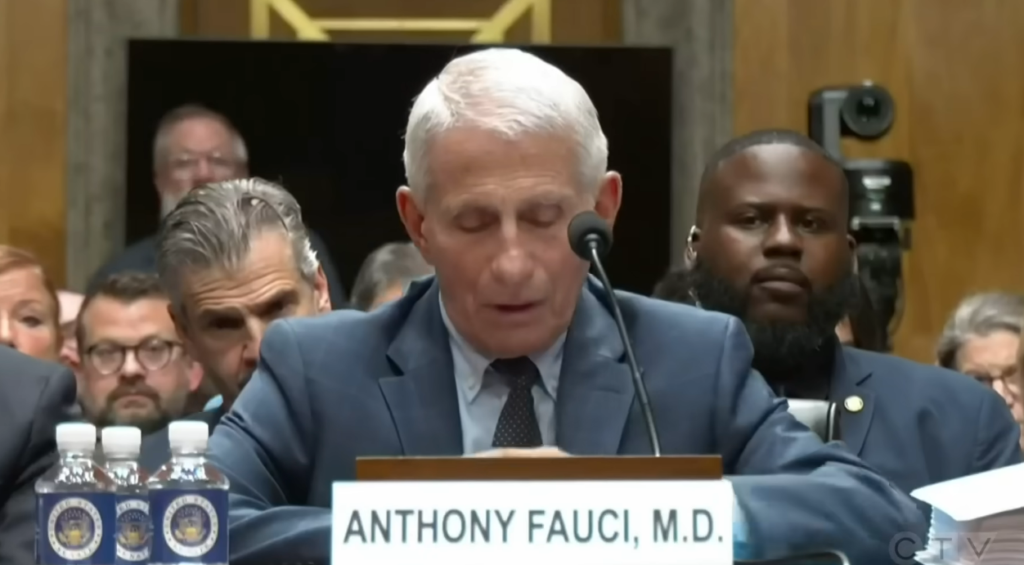
It’s almost strange to see an 85-year-old man who used to work as a presidential advisor refuse to answer any questions from a Senate committee over and over again. That was Wednesday in Washington, D.C. Dr. Anthony Fauci was summoned to testify before the Senate Homeland Security and Governmental Affairs Committee. He used his right under the Fifth Amendment not to testify against himself more than 100 times in the course of three hours. There were more and more questions. No one ever gave the answers.
No one chose for Fauci to be there. The committee’s leader, Republican Senator Rand Paul of Kentucky, issued a subpoena for him, so Fauci had no choice but to show up. What Paul couldn’t do was get real testimony. Even though President Biden gave Fauci a preemptive pardon in January 2025, his lawyers told him that speaking under oath was still illegal. This pardon covers all federal crimes that happened between 2014 and the day it was given. What it doesn’t cover is anything Fauci might say now under oath, which is something Republicans have been hinting at for months as a possible way for him to lie. From a legal point of view, it was easy: keep quiet, take the heat, and don’t give anyone new information to work with.
The hearing was tense in the way that hearings in Washington, D.C. are tense: it wasn’t loud, but it was loaded. David Schertler, Fauci’s lawyer, tried to get in the way of Paul’s questioning of his client at one point. Paul told Capitol Police to take him out of the room. After the fact, Schertler said it was outrageous and called the whole thing a “vindictive” exercise. It’s not clear if that frame is completely fair, but seeing a lawyer being walked out of the Senate chamber is a sight that is hard to forget. In his short opening statement, Fauci said that he thought Paul’s only reason for calling him was to get information that could be used to charge him with a crime. “The only conclusion I can reach,” he said, “is that the sole reason he is calling me before this committee is to get me to say something — anything — that could vindicate his repeated public pledges that I end up, in his words, ‘behind bars.'”
Paul has long believed that COVID-19 came from a lab in Wuhan, China, and that research funded by the U.S. at the Wuhan Institute of Virology may have played a part in the outbreak. He has also said that Fauci lied to Congress about whether the National Institutes of Health supported gain-of-function research, which is a technically false claim that Fauci has always denied. A few days before the hearing, Paul made public more than 1,100 pages of Fauci’s diary entries from the time of the pandemic. The entries were made on a government computer and were considered government records. In early 2020, before he became more public about his belief in a natural origin, Fauci wrote in his diary that he was privately thinking about both the natural origin and the lab leak theories. His supporters say this is just how scientists deal with not knowing what will happen. Paul had a different take on it.
It’s important to note that most scientists still believe the natural-origin theory, which says the virus got from animals to people, most likely at a Wuhan wildlife market. That theory has been called the “best supported” one by the World Health Organization. But the U.S. intelligence community doesn’t agree on what to do. Both the FBI and the CIA think that something that happened in a lab is the most likely cause, though the CIA did so with little confidence. The National Intelligence Council and some other agencies are still not sure or lean toward a natural origin. That disagreement doesn’t end the debate, but it does help explain why it hasn’t gone away like some people thought it would.
At the end of the hearing, Paul said that Fauci would be found guilty of contempt of Congress by the committee the following week. A Republican named Florida’s attorney general also said he would start an investigation at the state level. During the whole hearing, Democrats on the committee pushed back. Senator Gary Peters called it a “partisan exercise” with a predetermined outcome instead of proper oversight. Maggie Hassan, a senator, said that the whole process was “designed to trap” Fauci. These criticisms haven’t made a big difference in Paul’s life, and it’s still not clear what a contempt referral would actually do—the path from a contempt vote to criminal prosecution isn’t easy or quick.
One thing the hearing did create was a kind of unresolved tension that has been following Fauci since 2020. For a while, he was one of the most well-known people in the country. He was the face of a government response that was disorganized, controversial, and always changing. In 2021, Trump praised him as a presidential commendation for his work on Operation Warp Speed. After many years, they took away his security. What happened in that Senate hearing room on Wednesday doesn’t say as much about how the pandemic’s legacy is being fought as the way that relationship has changed over time.
| Detail | Info |
|---|---|
| Hearing Date | Wednesday, July 29, 2026 |
| Committee | Senate Homeland Security and Governmental Affairs Committee |
| Chaired By | Senator Rand Paul (R-KY) |
| Fauci’s Age | 85 |
| Former Role | Director, NIAID (National Institute of Allergy and Infectious Diseases) — 38 years |
| Amendment Invoked | Fifth Amendment (self-incrimination) |
| Times Invoked | More than 100 times |
| Biden Pardon | Granted January 19, 2025 — covers federal offences from 2014 to January 2025 |
| Key Accusation | Misleading Congress on gain-of-function research; alleged COVID origins cover-up |
| Fauci’s Lawyer | David Schertler — removed from hearing room by Capitol Police |
| Contempt Vote | Paul announced committee vote the following week |
| COVID Origin Views | Most scientists favor natural origin; FBI and CIA lean toward lab leak (low confidence) |
| Florida AG Response | Announced investigation into Fauci following the hearing |
| Trump’s Comment | Called Fauci “crazy” on social media during the hearing |
