

For many years, frequent travelers who had firsthand experience with Kansas City International Airport used it as the subject of a particular type of joke. A shuttle bus and the common humiliation of having to re-enter security if you needed to switch airlines were the only connections between the three distinct terminals from 1972, each essentially its own isolated building. There weren’t many food options. The lines of security were dispersed. The entire experience conveyed, through its subdued architectural style, that Kansas City was not a destination worth visiting but rather a city you passed through. That all changed in one morning on February 28, 2023.
Because Tuesdays have about 30% less air traffic than Fridays, airlines can move equipment overnight without experiencing operational chaos. This is why the new terminal opened on a Tuesday. The first flight left early for Chicago, where the previous night’s final flight from the old terminal had flown. By most accounts, the handoff was smooth and intentional. Built on the site of the demolished old Terminal A, the new structure took three years to complete. It was completed on time and within budget, which is uncommon for major public infrastructure projects, and Kansas City Mayor Quinton Lucas was not afraid to celebrate.
| Kansas City International Airport (KCI) — New Terminal Key Information | |
|---|---|
| Airport | Kansas City International Airport (KCI/MCI), Kansas City, Missouri |
| Terminal Cost | $1.5 billion |
| Groundbreaking | March 2019 (voter approval: 2017) |
| Opening Date | February 28, 2023 (on schedule and on budget) |
| Terminal Design | Single consolidated terminal (replaced three separate terminals from 1972) |
| Total Gates | 40 gates (Concourse A: 12 gates; Concourse B: 28+ gates) |
| Security | 16 lanes (centralized checkpoint; updated April 2026 to single central entry near Dunkin’) |
| Parking Garage | 6,000+ spaces across the street; red/green light tech for open spots |
| Dining (Local %) | 80% local vendors; includes Meat Mitch BBQ, Bo Lings, Boulevard Brewing Beer Hall, City Market Food Hall, Parisi Coffee |
| Public Art Budget | $5.65 million — largest public art project in Kansas City history (28 artists selected from 1,900+ applicants) |
| Notable Firsts | First Delta Sky Club at KCI; first sensory room and air travel experience room; first Touchless ID security lane |
| Major Events Enabled | 2023 NFL Draft; 2026 FIFA World Cup (Kansas City host city) |
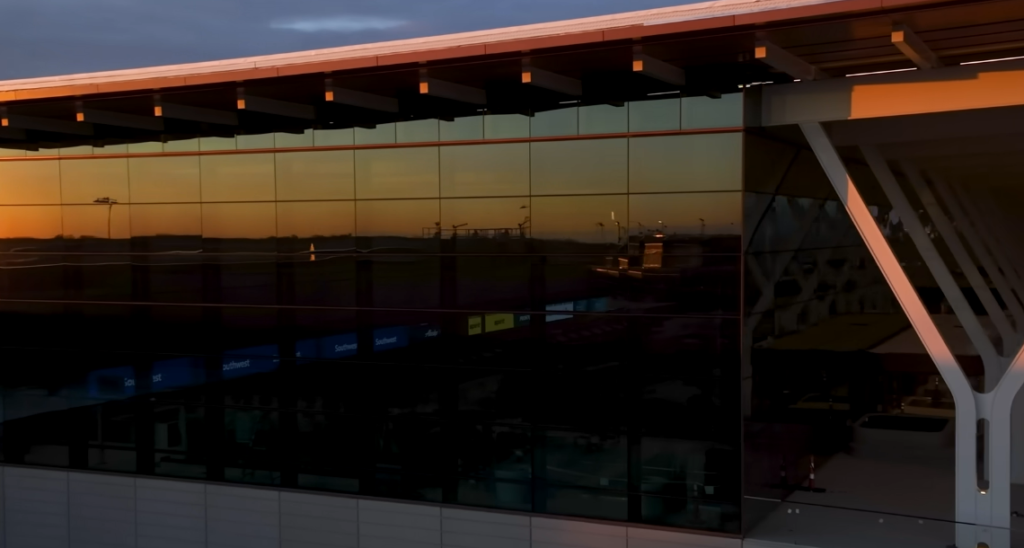
When travelers entered, they discovered something Kansas City had never had in its aviation history: a single, logically designed terminal. Arrivals and departures are divided by level rather than building. Directly across the street, a parking garage with 6,000 spaces is visible from the entrance. Each row’s red-green light technology indicates the precise locations of available spaces. a security checkpoint with sixteen lanes in one central location as opposed to being dispersed throughout several buildings. There are two concourses and forty gates. Concourse B is home to the first-ever Delta Sky Club at KCI, which can accommodate almost 200 people and has a bar and buffet.
The terminal’s strongest statement about Kansas City’s identity can be found in the food. Airport officials achieved their goal of having at least 80% local vendors. Meat Mitch Barbecue, Bo Lings Chinese, the Boulevard Brewing Beer Hall, a City Market Food Hall, Parisi Coffee, and Soiree Steak and Seafood House are all located in the concourses beyond the check-in desks. These are the real restaurants that Kansas Citians are familiar with, not a carefully chosen representation of Kansas City cuisine. In an area that welcomes millions of passengers each year, the city’s culinary identity—which residents have long believed is undervalued nationally—is on exhibit. It is a first impression in the strictest sense.
Although more difficult to measure, the art program is just as intentional. With a $5.65 million budget for artwork, it was the largest public art commission in Kansas City’s history. Over 1,900 applications were received, and 28 artists—the majority of whom had connections to the Kansas City area—were eventually chosen. On beige walls, the pieces are not ornamental accents. These include sculptures, murals, ceramics, and hanging installations that can be seen from the jetway connections and escalators. “The Air Up There” serves as the Check-In Hall’s focal point.”Molten Swing” is suspended at the baggage claim escalator descent. There’s a sense that the city chose to say something about itself here and meant it, especially if you’ve been gone for a while.
Beyond improving the traveler experience, the terminal has already produced some noteworthy results. The 2023 NFL Draft was held in Kansas City, drawing hundreds of thousands of people to the city center. It will now host the FIFA World Cup in 2026. Airport officials are direct about the connection: the new terminal’s capacity and credibility helped make those bids feasible. If a city wants to market itself as an event destination, it needs an airport that doesn’t make the pitch look bad. Despite its local appeal, the former KCI was not that kind of airport.
The most recent change was made in April 2026 when the Aviation Department reorganized the security checkpoint once more, combining the entry points from both ends of the terminal into a single central location close to the Dunkin’ Donuts in the check-in area. Although officials were quick to stress that the change was a permanent improvement rather than a temporary solution, it was designed with the World Cup summer in mind, with the peak crowds that come with hosting matches attracting fans from dozens of countries. A configuration that can handle the kind of volume a Wednesday before Thanksgiving or a World Cup quarterfinal brings is centralized entry, with all lane types in one location. It won’t be possible to fully test whether it functions as intended until the first significant surge passes.
There are still many issues that the terminal cannot resolve on its own. For example, frequent travelers have consistently criticized the road access and rideshare pickup logistics at the arrivals level since day one, and no amount of local barbecue at the gate can clear a crowded lower curb. Additionally, the airport is still calibrating. After three years, the Aviation Department continues to evaluate, modify, and improve. A functioning institution does just that. However, the cornerstone is something Kansas City actually lacked for fifty years: an airport that, upon landing and entering baggage claim beyond the “Welcome to Kansas City” sign at the bottom of the escalator, persuasively argues that the destination is worthwhile.
