

Watching a flamingo sleep causes a brief period of cognitive dissonance. A ball of pink feathers perched on a single, twig-like stilt, it appears dangerous, defying gravity and common sense. The same question has been posed for decades by both zoo visitors and scientists: Why? Is that a position from yoga? A means of drying off? A peculiarity of evolution?
It turns out that the solution is a bio-engineering masterclass. It is about being lazy in the most effective way possible, not about balancing in the active sense. Standing on one leg is actually less exhausting than standing on two, according to physics, which has finally caught up with the flamingo.
In order to decipher the code, a group of researchers from Georgia Tech and Emory University examined both living birds and, to a lesser extent, flamingo cadavers. They discovered something shocking. Without any help from others, a dead flamingo can sustain its own weight on one leg. The “passive gravitational stay mechanism”—basically, a locking system in the joints—is a feature of the bird’s anatomy. Straightening the leg causes the joints to snap into position, forming a hard pillar that needs no muscular effort to support.
Think of it like standing on two legs. A flamingo’s two-legged stance necessitates frequent, minute muscle modifications to keep it balanced; this is called “postural sway.” By standing on one leg, the locking mechanism is activated, transforming the bird into a stable tripod with its center of gravity and foot. According to studies, flamingos’ body wobble is actually seven times less when they are sleeping on one leg than when they are alert and awake. Unconsciousness actually makes them more stable.
Key Factual Context: Flamingo Biomechanics
| Feature | Details |
| Mechanism | “Passive Gravitational Stay Mechanism” (locking joints). |
| Energy Cost | Zero active muscle effort required to stand on one leg. |
| Stability | Postural sway is 7x lower when sleeping on one leg vs. active. |
| Thermoregulation | Minimizes heat loss in cold water (water draws heat 25x faster than air). |
| Anatomy | Center of gravity aligns directly over the standing leg; joints lock into place. |
| Reference | Royal Society / Biology Letters Study |
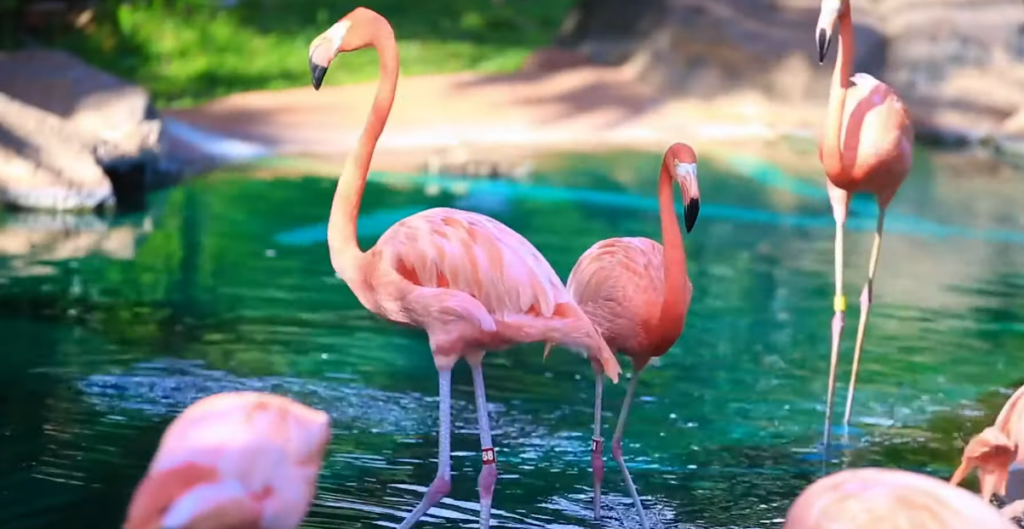
A flock of Chilean flamingos stood still for an hour at an Atlanta zoo, and I stood there, sweating in the humidity, and realized that their stillness was an active physiological achievement—or rather, a feat of active inaction.
There is a thermal imperative in addition to mechanical efficiency. The majority of flamingos’ lives are spent wading across water. Water steals body heat 25 times as quickly than air, making it a thief. The flamingo’s surface area exposed to the chilly, salty environment is cut in half by tucking one leg up under their downy plumage. Less leg in the water means more heat in the body, according to the straightforward thermodynamic equation.
The flamingo is brilliant because it doesn’t have to decide between conserving heat or energy. The one-legged position addresses both issues at once. The bird may rest, digest, and retain heat in this extremely economical posture without using any energy to stand up. Therefore, keep in mind that a flamingo isn’t flaunting itself the next time you see it sitting on one leg. It’s just more efficient than you at following the principles of physics.
