

This December, the radio in Essen conveyed emotion, urgency, and community in addition to music. WDR 2 transformed its broadcast studio into an open center of charity for 107 hours in a row, where songs told tales and stories turned into donations. What started off as a neighborhood charity idea has developed into something really inventive—a public custom with actual financial significance.
The Spendenstand Weihnachtswunder 2025 reached an incredible €15,644,256 by the campaign’s finale on December 17. Not only was this amount high, but also broke records and was far more than the €12.1 million raised in 2024. Families, retirees, companies, and schoolchildren all made donations. Simple requests like “Play ‘Angels’ for my late mother” or “This is for the nurse who cared for me during chemotherapy” were frequently made. However, those messages were the result of thousands of small gestures that came together to create something quite powerful.
The format was still endearing. Donations and song requests were submitted by listeners. These demands turned into the broadcast’s lifeblood. Hosts maintained a lively atmosphere, yet there was also time for introspection. The remarks of some donors were played over instrumentals, while others were read out loud. This combination of fun and emotion turned out to be quite adaptable. Whether the donation was €5 or €500 made no difference. Because they were all public, intimate, and rooted in empathy, they all felt significant.
Bishop Franz-Josef Overbeck made one donation when he visited the glass studio and gave €77,815.10 on behalf of the Essen Diocese and its bank. It was a collection gathered through bake sales, scout-led walks, and small neighborhood fundraisers rather than a large gift from a wealthy contributor. He commented on how serene the mood was while he was there. He stated, “People want to help.” “And they’re working together on it.” His voice was serene, almost astonished at the strength of teamwork.
| Campaign Name | WDR 2 Weihnachtswunder 2025 |
|---|---|
| Location | Burgplatz, Essen, Germany |
| Duration | 13–17 December 2025 (107 hours live) |
| Funds Raised | €15,644,256 (new record) |
| Donation Method | Music requests via live broadcast |
| Beneficiaries | Aktion Deutschland Hilft, Tafel NRW, 30+ global aid projects |
| Contributors | Over 77,000 donors; supported by church, businesses, schools |
| Reference | WDR Coverage |
Later, I was struck by how simple the quote was and found myself repeating it. Sometimes it’s just that simple: people want to be helpful.
The total amount donated indicated something more comprehensive. Many Germans have voiced their dissatisfaction with top-down charity models. Weihnachtswunder provided a substitute. It gave people the freedom to decide what song to attach, how to contribute, and what message to express. Because of this freedom, it is very effective in fostering interpersonal relationships while yet having a discernible effect.
Over the course of the five-day event, over 77,000 song requests were received. Some were heartbreakingly honest, while others were humorous. In honor of her grandma, a young woman requested a lullaby from her early years. A long-haul truck driver asked for AC/DC to keep him going while donating from a rest area on the A40. A class of fourth graders from Dortmund sent in their teacher’s name with a giggle after pooling €30 for a Taylor Swift song. Every one of these instances woven into a generous tapestry that seemed remarkably resilient.
The money will go toward a variety of philanthropic endeavors. The campaign’s main partner, Aktion Deutschland Hilft, intends to use the funds for more than 30 humanitarian initiatives, ranging from medical assistance in disaster areas to famine relief. A portion will be given to local food banks like the Tafel NRW, which will help families who are having trouble keeping up with rising expenses. Because people can see where the money is going and why it matters, the transparency of this effect pathway has significantly increased public trust in charitable initiatives.
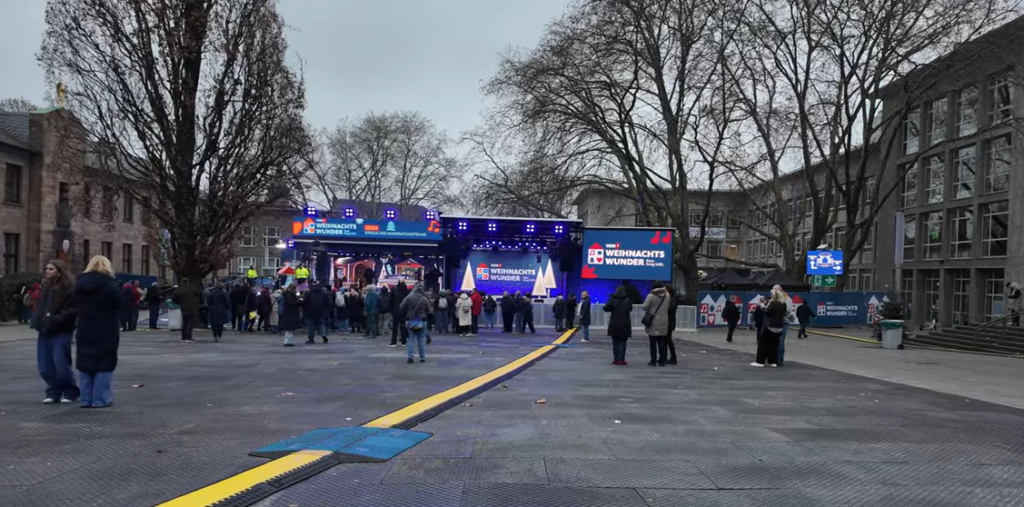
This year, the mood surrounding Burgplatz may have caught most spectators off guard. It was dry and freezing outside. Hours passed with crowds. Many came simply to watch the magic happen through the glass, while others brought coffee and blankets. No gatekeepers, no admission fee. Only a common experience. In between live broadcasts, local choirs performed and volunteers distributed hot beverages. It was joyous but grounded. Not sentimental, but optimistic.
Additionally, this media campaign was free of commercial collaborations and celebrity cameos, in contrast to many others. It was driven by grassroots energy; as the music played, volunteers answered calls, messages were read aloud, and donations were processed. What might have come out as staged instead was remarkably genuine.
On the last night, there was a late moment that I will never forget. A seventy-year-old woman from Münster called in and donated €10, writing, “I’ve always wanted to feel useful again.” I appreciate you allowing me to participate.
I remembered that line more than the figures.
Treating fundraising totals as scores is simple. However, the goal of this campaign is community, not competitiveness. That €15.6 million amount is more than just a statistic; it’s a gauge of the public’s compassion, fortitude, and inventiveness. The way that empathy has been translated into action—without coercion or spectacle—is very advantageous.
WDR 2 has consistently improved the idea since Weihnachtswunder began in 2021, expanding access, simplifying logistics, and making room for more in-depth involvement. It is no longer merely a broadcast. It serves as a reflection of the kind, considerate, and connected persons that people aspire to be in December.
Latecomers have an opportunity to join the movement as donations are still being accepted through mid-January. However, the actual effect has already occurred. Thousands of stories were told, voices were heard, and hands were extended—not just in euros.
