

The current American Airlines shutdown has become a crisis reminiscent of previous government funding lapses, but with a noticeably calmer atmosphere in the airspace. The FAA has caused an unprecedented operational slowdown that goes beyond normal travel disruptions by imposing a four percent cut to flight schedules at forty major airports.
American Airlines executives have made it clear that the decision to cut departures was made for safety reasons rather than political considerations. However, the shutdown’s origins can be found in a political impasse that has prevented thousands of federal employees—including air traffic controllers, who are essential to safe air travel—from receiving their salaries. Their absence has severely limited the FAA’s ability to safely monitor the skies; some have called in sick, while others have taken temporary positions.
The seriousness of the situation was highlighted by Transportation Secretary Sean Duffy’s warning that flight cuts could increase to 20%. He made a very clear assessment: the system can only withstand so much stress before safety is jeopardized. In response, United and Delta modified their own operations and American Airlines announced 220 daily cancellations, impacting an estimated 12,000 passengers daily.
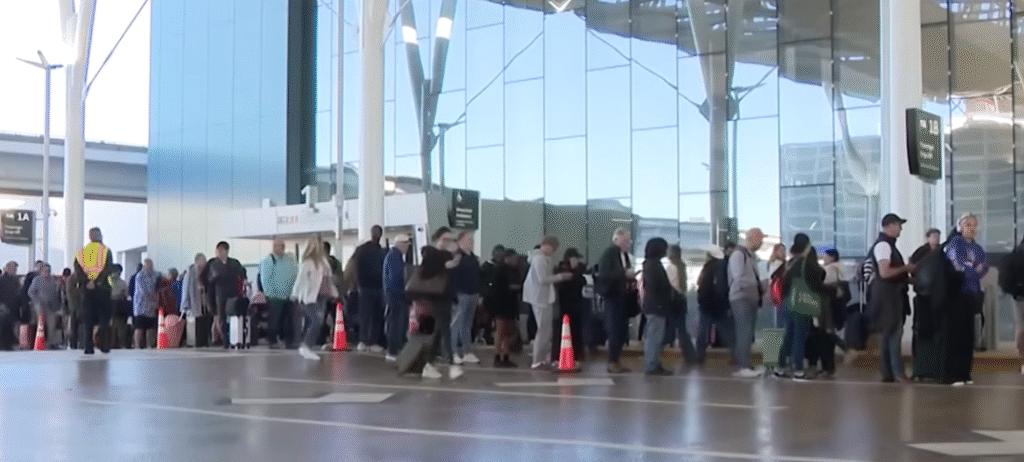
Terminals hummed with annoyance at major hubs like Dallas–Fort Worth and Chicago O’Hare. The red flickering of the delay boards on the screens reflected a general feeling of unease. While some passengers expressed sympathy for federal employees who continued to direct flights through crowded air corridors despite missing paychecks, others detailed waiting hours without updates. Their ability to remain professional under pressure has been impressive.
Overview Table
| Item | Details |
|---|---|
| Airline | American Airlines |
| Event | Flight reductions and partial shutdown of domestic operations |
| Cause | Government funding lapse leading to air traffic controller and TSA pay issues |
| Affected Flights | About 220 daily departures cancelled initially |
| Duration | Commenced early November 2025 as FAA mandated flight cuts |
| Key Authority | Federal Aviation Administration (FAA) |
| Major Impact | Reductions at 40 busiest U.S. airports; delays and cancellations rising |
| Sector Influence | Aviation, travel, infrastructure and national security |
| Reference Link | Reuters – US warns it could force 20% flight cuts if shutdown continues |
American Airlines, a remarkably adaptable organization, has made an effort to adjust by rerouting passengers, removing change fees, and providing complete refunds. Bottlenecks in logistics still exist, though. Every cancellation has an impact on crews, gate slots, and subsequent flights along interconnected routes. To avoid a total system freeze, the airline’s crisis management teams have been putting in a lot of overtime, optimizing processes and releasing resources.
The cost of the shutdown is not limited to ticket refunds from an economic standpoint. Losses are being absorbed by local economies centered on airport traffic, hotel chains, and ridesharing services. According to a study conducted by the U.S. Travel Association, the economic impact of air disruptions nationwide is estimated to be close to $150 million per day. The total financial hit could be particularly severe if the FAA increases cuts to 10 percent or more.
However, in the midst of the logistical chaos, there is a larger discussion about dependence and how closely government operations are linked to air travel. The entire aviation system collapses when TSA officers or air traffic controllers are not compensated, demonstrating the true interdependence of private enterprise and federal stability. Like other carriers, American Airlines is only the outward manifestation of a much more intricate system that depends on imperceptible accuracy.
Industry watchers point out that this development could hasten investments in advanced communication systems, automation, and AI-assisted scheduling. Airlines may be able to continue operating in some capacity during nationwide disruptions by utilizing these technologies. The concept is especially novel and has the potential to change how aviation systems function in times of political unpredictability.
One passenger, a Kansas museum director, spoke about the emotional burden of boarding a plane at Reagan National Airport knowing that controllers may be working for free. Echoing the sentiment of millions, he said quietly, “I’m entrusting my life to people under immense stress.” His comment encapsulated a common tension—assurance tempered with compassion, uneasiness tempered with appreciation.
Robert Isom, the CEO of American Airlines, was open about the long-term effects. Although the company’s immediate response was very effective, he acknowledged that if the shutdown continued, “sustaining this level of disruption” would become problematic. Despite its commendable operational resilience, the airline has limitations that even its sophisticated contingency models cannot sustain indefinitely.
This episode reminds frequent travelers that weather and engines are not the only factors that affect flight reliability. Governance—the frequently unseen framework of cooperation, control, and shared responsibility—is essential. Even the best-run airlines encounter uncontrollable turbulence when that structure deteriorates.
Nonetheless, there is still hope in the aviation industry. According to a number of experts, the crisis may lead to changes that increase system transparency and response times. It is hoped that better coordination between government agencies and airlines may result from the lessons learned from this shutdown. With future uncertainties like funding snags and climate disruptions looming, the potential for improved contingency planning is especially advantageous.
The closure of American Airlines has rekindled social debates about empathy and justice. Previously expressing only frustration, passengers now recognize the human cost of the delays. Travelers have been reminded by TSA officers, air traffic controllers, and airline employees—all carrying out vital duties—that decorum is still crucial during disruption. It has become a silent testament to resiliency to see an exhausted crew still grinning at the boarding gates.
