

The valsartan recall has established a standard for how a small molecule can undermine trust in contemporary medicine around the world. Once prescribed daily to millions of people, a blood pressure medication turned into a warning about chemical impurities and manufacturing shortcuts. Regulators noticed something that shouldn’t have been there, and the story didn’t start out in a panic.
The European Medicines Agency discovered N-nitrosodimethylamine (NDMA) traces in valsartan manufactured by Chinese supplier Zhejiang Huahai Pharmaceuticals in the middle of 2018. Science has long known that NDMA is a chemical that was once employed in industrial processes and is likely carcinogenic. When the company changed its production process and introduced a reaction that inadvertently produced NDMA, the impurity was unexpectedly found. Despite being technically minor, the change had a profound impact.
Once discovered, the discovery set off a global chain reaction. The U.S. Food and Drug Administration was notified by European regulators, and recalls quickly ensued. The FDA’s advice to patients not to stop taking their medication suddenly was incredibly successful. The logic was very obvious: stopping blood pressure medication abruptly can result in heart attacks or strokes, which are far more serious side effects than the possible long-term cancer risk that NDMA exposure could cause.
Product Overview
| Drug Name | Valsartan (Angiotensin II Receptor Blocker) |
|---|---|
| Use | Treatment of high blood pressure, heart failure, and recent heart attack |
| Recall Reason | Contamination with probable human carcinogen N-nitrosodimethylamine (NDMA) and other nitrosamine impurities |
| Began | July 2018 and expanded in following years |
| Impacted Area | Generic and brand versions, global markets including U.S., Europe, Canada and developing countries |
| Core Concern | Long-term exposure to contaminated batches may elevate cancer risk; abrupt withdrawal may also be harmful |
| Reference | U.S. Food & Drug Administration (FDA) “Updates & Press on ARB Recalls: Valsartan, Losartan and …” link |
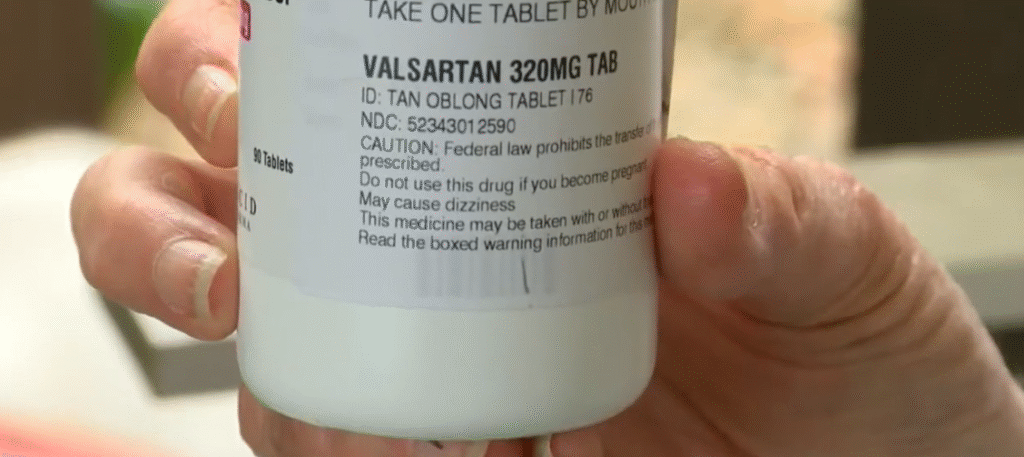
The advice was compassionate but firm: look up the manufacturer’s name on the pill bottle, speak with your pharmacist, and keep taking the medication until a safe substitute is found. Even though it seemed straightforward, that instruction ended up being a lifesaver for nervous patients who were comparing lot numbers and scrolling through recall lists. Many found the experience to be remarkably similar to reading food recalls, with the exception that the risk was their daily lifeline.
Soon, pharmacies evolved into information hubs. Assuring patients that not all valsartan products were impacted, pharmacists answered an endless number of calls. Physicians also experienced a crisis of confidence, explaining chemistry rather than cardiology. The incident demonstrated the close relationship between public trust and manufacturing precision. It also made people wonder how health systems from New Jersey to New Delhi might be affected by a single, minor impurity in a single factory.
Globalization was the solution. Pharmaceutical supply chains span continents, with active ingredients being made in one nation, turned into tablets in another, and then shipped all over the world. Although this structure is extremely effective, it is also extremely brittle. Contamination quietly permeated supply lines like ink in water when Zhejiang Huahai’s procedure went awry. Millions of people had already purchased the products by the time the problem was brought to light.
A new era of global accountability was heralded by the FDA and EMA’s investigations becoming transparent and cooperative. The agencies tracked NDMA and other nitrosamines, including NDEA and NMBA, through various batches and businesses using extensive laboratory testing. Through the integration of sophisticated mass spectrometry and chromatography techniques, regulators were able to identify contamination levels as low as nanograms. Because of this process’s high efficiency, future manufacturing will continue to be safer, cleaner, and noticeably better.
The wider ramifications extended beyond a single medication. All angiotensin II receptor blockers (ARBs), including losartan and irbesartan, were reviewed in response to the valsartan recall. The industry discovered that chemical shortcuts, which were implemented to save money or time, can result in minute mistakes that have far-reaching effects. This discovery was especially helpful for drug safety around the world since it forced pharmaceutical companies to implement more stringent quality controls and to rigorously validate every synthetic step.
Soon after, lawsuits were filed. Patients accused manufacturers of being careless and failing to maintain transparency and safety. According to some reports, the recall caused emotional harm, including anxiety, mistrust, and restless nights, especially in the United States. The Valsartan case became a classic illustration in both legal and medical circles of why “trust but verify” is more than just a catchphrase—it’s a requirement.
It’s interesting to note that people became more conscious of pharmaceutical origins. People who had previously accepted their prescriptions without question started to inquire about the origin of their pills. This curiosity is especially creative because it turns inattentive consumers into knowledgeable participants. Patients indirectly influence the industry to uphold accountability by challenging sources.
The recall’s impact on society reflected changes in transparency in culture. The drug industry started to face a new demand: visible honesty, much like how environmental audits changed consumer goods or how food labeling changed after allergy scandals. Regulators urged manufacturers to make test results available to the public and published lists of drugs that were “nitrosamine-free.” Despite being administrative, these actions restored damaged faith.
The impact on the economy was complicated. While some manufacturers experienced harm to their reputations, others who kept their supply chains clean were rewarded with new contracts and trust. The market correction was both painful and necessary, according to analysts. In retrospect, the recall acted as a purge, eliminating inferior procedures and boosting trust in long-term quality. It also showed how data-driven, not panic-driven, regulation can be remarkably effective.
From the standpoint of the patient, the recollection became intimate. On the internet, people shared their experiences; some were appreciative of the proactive regulation, while others were angry about the delays in replacements. These discussions were unexpectedly open and relatable. They exposed a fundamental reality: when people feel informed, they are more likely to forgive errors, but secrecy quickly shatters that connection.
Health care providers also gained knowledge. Doctors learned from the recall to communicate risk without fear, strike a balance between assurance and realism, and stress that being vigilant does not equate to alarmism. It served as a moment of reorientation for medical institutions, serving as a reminder that trust built via clarity is just as important to modern healthcare as science.
Prevention is the most promising result. Pharmaceutical companies are now required by the FDA, EMA, and other international regulators to evaluate and manage nitrosamine risks for all medications, not just ARBs. Nowadays, contaminants at previously undetectable levels can be found using new testing techniques like GC-MS/MS systems and LC-HRMS. The pharmaceutical industry is now much quicker at identifying risk and safeguarding patients before problems worsen thanks to the use of these analytical tools.
